

Don’t stop the rot
A look at the wonderful world of mouldy, rotten drinks
We all know that feeling of revulsion when, after catching a whiff of something ‘not quite right’ emanating from the fridge, reluctant rummaging reveals a tub of long-forgotten leftovers. The sight of fungal fur spreading its invisible tentacles over our food is enough to turn even the strongest stomach. Yet fungus and bacteria-ridden ingredients can be vital to some highly sought-after drinks. And we’re not talking pleasantly smelling yeast, which is, of course, a fungus. We’re talking rotten.
In Japan, mouldy drinks go back over a thousand years. There the brewing of sake is considered an ancient art, and at the heart of the process is the highly prized ‘koji’, internationally better known as the fungus Aspergillus oryzae. In a counter-intuitive practice, koji spores are sprinkled onto damp rice, which is left to fester until the white fungal fluff becomes visible. This is then fermented with water and yeast to make a potent brew. The mould is necessary because it produces enzymes that break down the rice starches into sugars. These are then fermented, producing up to 24% ethanol ABV within just 20 days. It’s a process that Daniel Kerruish, a microbiologist who carried out doctoral research on koji at Nottingham University and who now works as a brewing consultant, describes as “bizarre” and “incredible”.
The beauty of koji, he explains, is its complexity. It doesn’t just release sugars, but also influences flavour and, thanks to its release of nitrogen, mouth-feel, giving more ‘texture’ and body. Different strains of koji produce varying sugar and mouth-feel profiles, and some sake brewers have their own unique koji ‘brands’. Indeed, so serious are the Japanese about koji – which is also used to make the distilled spirit shochu, as well as soy sauce and miso – that it has been officially designated the National Fungus of Japan.
No one really knows what possessed the Japanese to start experimenting with mouldy rice. Consuming mould is generally a bad idea, and can entail serious health risks. Take ergot, for example, a fungus which grows on grains and which, when eaten, produces a long list of terrifying symptoms. These include: itching, spasms, seizures, numbness, nausea and vomiting, diarrhoea, swelling, gangrene, and, most strikingly, hallucinations and psychosis. Outbreaks of ‘ergotism’ have been recorded throughout the centuries and mass psychosis caused by ergot poisoning has been put forward as an explanation for, among other things, the mysterious abandonment of the Mary Celeste. Its twitchy, burning seizures and erratic behavioural traits, meanwhile, have separately been blamed for events leading to the infamous Salem Witch Trials. And mould poisoning isn’t confined to history. In 2003, 120 people were reported dead in Kenya after eating mouldy corn.
Early koji experiments may, in fact, have been a bit ‘hit and miss’. Kerruish points out that while Aspergillus oryzae is completely safe for human consumption, its close relative Aspergillus flavus is not. It produces dangerous aflatoxins – the poisons responsible for the 2003 Kenyan deaths – which can cause acute liver disease. DNA sequencing has shown that domesticated Aspergillus oryzae has only two of the 25 genes necessary to produce aflatoxins, suggesting that they may have been gradually bred out over generations.

No one really knows what possessed the Japanese to start experimenting with mouldy rice. Consuming mould is generally a bad idea, and can entail serious health risks
Although Aspergillus oryzae is a common fungus, its use in food and drink production appears to have been limited to East Asia (it is also used to produce the Chinese and Korean drinks huangjiu and makgeolli). Nevertheless, there are other examples of fungal and bacterial tipples closer to home.
Such as ginger beer, for example. The original British summertime staple that used to be poured out in lashings and lashings is far removed from the carbonated drink sold in bottles and cans today. ‘Real’ ginger beer is actually made from a ‘ginger beer plant’, which, confusingly, is not a plant at all, but a symbiotic colony of bacteria and yeast (or ‘SCOBY’ for short), which resembles translucent slime. When placed in water, with sugar and ginger, and left for around a week, the plant produces a drink which is naturally fizzy, slightly alcoholic and, thanks to the presence of Lactobacillus hilgardii bacteria, strikingly tangy.
No one knows where ginger beer plant came from, or how it ended up on windowsills all over Britain. One theory is that it was brought back by British soldiers fighting in the Crimea – SCOBYs such as kefir and kombucha are common in parts of Russia. At any rate, it has been around for well over 100 years, despite suffering a severe decline during the Second World War, when sugar rationing severely hampered its cultivation.
Since the plant grows with each ‘feeding’, bits of the slimy blob would be passed around periodically between neighbours and friends, accumulating an increasingly complex mishmash of microbes over the years, of which the drinkers would be blissfully unaware. By the time a selection of plants were first analysed by the botanist Harry Marshall Ward in the late 19th century, around a dozen different micro-organisms were discovered, all chumming along happily in the sludge. Just like koji, ginger beer plant is harmless to humans. However, fellow-SCOBY kombucha has been linked with some unpleasant side effects, including nausea, vomiting, allergic reactions, head and neck pain, jaundice and, in rare cases, death.
Making a drink for children from slimy blobs of bacteria may seem a bit strange, but arguably even weirder is ‘the noble rot’. For wine makers, the sight of their luscious grapes shrivelling under spidery webs of decay is usually the stuff of nightmares, but occasionally a fungal infection can give reason to pop a celebratory cork.
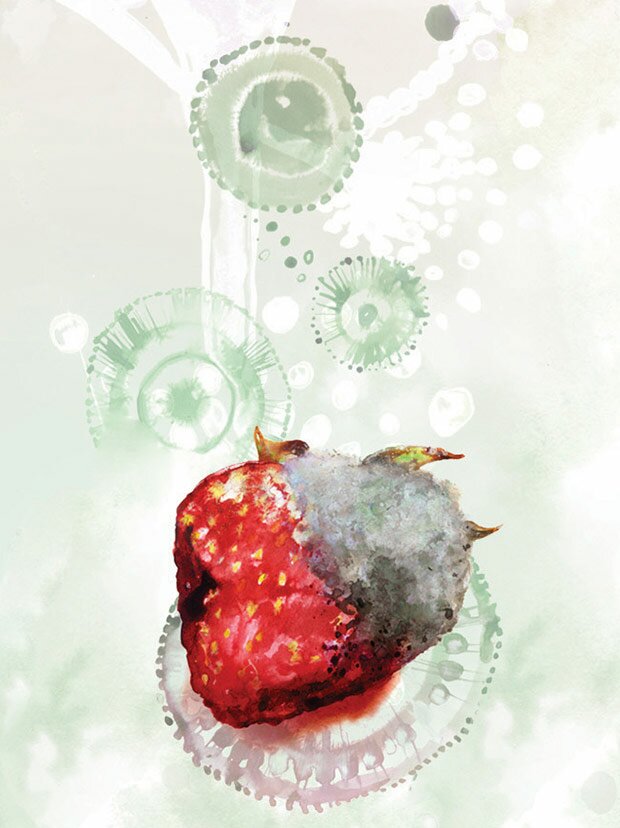
Botrytis cinerea (alternatively known as, ahem, Botryotinia fuckeliana) is a common fungus which attacks around 200 different plant species, and is the same grey, fluffy mould which is commonly found festering in neglected fruit bowls. It is one of the most common fungal diseases to affect grapes and, in most cases, will wreak havoc in a vineyard. In certain circumstances, however, it can actually help wine makers.
Chris Steel is Professor of Viticulture at Charles Sturt University, New South Wales. He explains that the key is for the mould to strike at the end of the growing season, when the fruit is over-ripe. “In this situation the fungus grows very slowly on the surface of the fruit without invading the tissue. This is because the fruit has started to shrivel and dehydrate and the loss of the water content means that the sugars become concentrated,” he says. “The fungus further dehydrates the fruit, concentrating the sugar and it also forms glycerol – a simple molecule that is viscous and enhances the sweet sticky characters of the fruit.”
The result is wines that are much sweeter, with a distinctive flavour (honey and beeswax, anyone?), and highly prized. Well-known examples are French Sauternes and Hungarian Tokaj, but there are noble rot wines made all over the world. “Botrytis is very easy to grow. What is difficult is to get the right conditions in the vineyard,” Steel explains. “Hot dry summers, followed by autumns that have cool humid nights and warm conditions during the day are ideal conditions.”
Sadly, saving up your furry, rotten strawberries won’t deliver you an exquisite fruit wine. “You would get all those bad off-flavours that you get with grapes that have grey mould. This is because you would never get the sugar content of the strawberries to be as high as what we find in over-ripe dehydrated grapes.”
As with sake, it’s not clear exactly who first began making wine with mouldy grapes, or why, but it is not a recent innovation – a mention of wine made from botyrised grapes in Hungary appears in a document from the 16th century. It may have been born of necessity after a failed harvest, or perhaps of curiosity and deliberate experimentation. The idea is not as crazy as it may at first sound. After all, mould and bacteria are used in both cheese and sausage making, so why not in drinks?
Perhaps the real question is not why rotten ingredients are occasionally used, but why they are not used more often. In 1898, at Criterion Restaurant in Piccadilly, London, a Mr Frank E. Lott presented a paper on the impact of mould on malt to the Federated Institutes of Brewing. His conclusion was that, in addition to yielding less sugar, mouldy malt had the curious effect of inbuing a beer with a smoky flavour. Nothing much seems to have come of this discovery, and maybe that’s for the best. But in a beer industry straining to constantly present us with new and surprising re-workings of the beer style canon, and in which novelty and innovation are prized, perhaps there is a niche for some counter-intuitive experiments. Bacteria have begun to see a comeback, thanks to the ‘wild’ brewing trend inspired by Lambic beers. Who knows – perhaps mould could be next.

Enjoy this article?
This is an excerpt from Hot Rum Cow Issue 8 which is available to buy in our shop. Buy magazine