
We owe Sir Kingsley Amis a drink
In fact, we owe him a bottle. If it wasn't for Everyday Drinking, his idiosyncratic guide to snifters, Hot Rum Cow would never have happened
Back in 2011, when we were planning to launch the magazine we couldn’t decide what to call it. Mash & Must and Hopscotch were early front-runners. Other options on a long shortlist were: Blotto, Chin Chin and Yardarm. But nothing seemed quite right.
Then Amis came to the rescue. Flicking through the index of his book, we found some wonderfully evocative names of cocktails, such as Jittersauce, Dizzy Lizzy and Salty Dog. But best of all was Hot Rum Cow. Three words, three syllables. What a strange phrase. What a perfect name for a magazine that wanted to stand out from the crowd.
But our attraction towards Everyday Drinking went further because, for all his faults, there was much in Amis’s curiosity towards booze that chimed with us; a sense of wonder that we have embraced editorially.
But before we proceed – a warning. Everyday Drinking is one of the few books that can give you a hangover without you having to drink anything. As the author guides you through a procession of every alcoholic beverage imaginable, your tongue may begin to feel as sticky as the floor of his legendary cocktail cabinet.
And while Amis’s experimentation is highly entertaining, his story doesn’t end happily. Best known for his comic novel Lucky Jim (1954), Amis was an academic and a prolific author of fiction, non-fiction and verse. But apart from his alcoholism, he had a troubled home life and umpteen affairs. His first wife, Hilary Bradwell, famously took a picture of him lying comatose on a Yugoslav beach in his trunks. Using a lipstick, she had scrawled on his back: ‘One fat Englishman – I fuck anything’.
A second marriage began passionately but disintegrated in rancour, with Amis unable to accept any criticism of his behaviour and full of remorse at losing Hilary. When the marriage collapsed, he returned to Hilary – which would have been unremarkable were it not for the fact that she was by then living happily with her third husband, Lord Kilmarnock. It was apparently an amicable arrangement, despite Amis’s regular stumbles and ill health, the inevitable consequence of a daily routine that, by that stage, usually began by downing a bottle of Scotch.
So proceed with care, dear reader. And don’t be deceived by an opening note from the unnamed Bloomsbury editor who describes Amis as “a scholar and practitioner and, perhaps above all, a connoisseur”. The author’s taste in drinks is far more interesting and bizarre than the word ‘connoisseur’ implies.
For instance, after a brief and atypical period on the wagon, Amis celebrates his return to booze in the book with a glass of gin and water followed by one of his favourite drinks, a chilled can of Carlsberg Special Brew. Yes, you heard that right – Carlsberg Special Brew, the sweet, high-strength canned lager also known as ‘tramp juice’. He later adds that, on a day-to-day basis, he prefers to dilute his Special Brew with Carlsberg Pilsner. “Special Brew is a wonderful drink,” he writes. “But after a certain amount of it you tend to fall over. To quaff the two of them half and half, really cold, out of a silver tankard produces as much goodwill as anything I know.”
Much of the fun in the book also lies in the delight that Amis takes in strange booze concoctions. Perhaps the oddest of these is Cock Ale, which he discovered in F. C. Lloyd’s Art and Technique of Wine. In brief, this involves marinating a parboiled and crushed large cockerel (“the older the better”) with sweet white wine, raisins, mace and cloves in a canvas bag and then plunging it into 10 gallons of ale for a couple of weeks.
Amis doesn’t reveal if he has ever tried Cock Ale, but he happily samples other curious concoctions. A good example is Queen Victoria’s Tipple, which simply involves filling half a tumbler with claret and then topping it up with Scotch. The story goes that Queen Victoria drank it daily. In a more recent book (Sediment: Two Gentlemen and Their Mid-Life Terroirs by Charles Jennings & Paul Keers), Jennings repeats the experiment with amusing consequences.
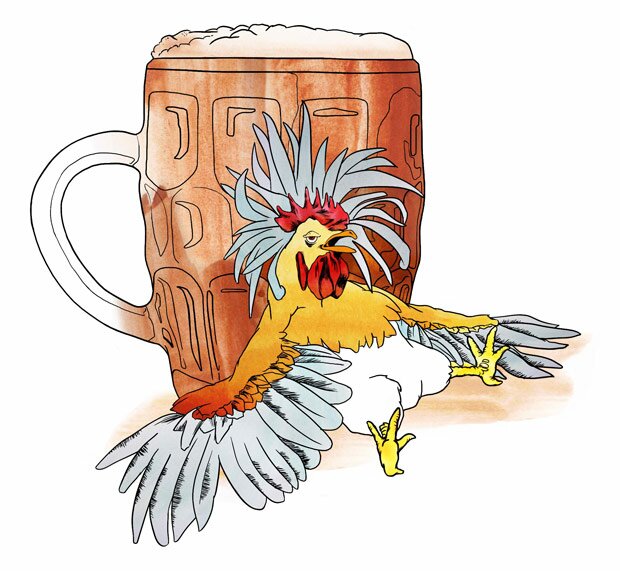
Or how about a breakfast cocktail? Amis has the very thing – Paul Fussell’s Milk Punch. Make milk ice cubes the night before. Upon rising, mix one part brandy and one part bourbon with four parts of fresh milk, drop in the milk cubes, dust with nutmeg and consume. It is, writes Amis: “An excellent heartener and sustainer at the outset of a hard day.”
If that doesn’t appeal, how about Reginald Bosanquet’s Golden Elixir? Named after a former British newscaster with a legendary passion for ‘everyday drinking’, it is simply Champagne topped up with peach juice. Or, for those of a more savoury persuasion, there is the Polish Bison – hot Bovril with vodka, lemon juice and pepper.
Amis also marvels at The Tigne Rose, a Saturday lunchtime aperitif once offered to new subalterns in the British Army barracks at Tigne, Malta. It consisted of a tot each of gin, whisky, rum, vodka and brandy. Even the usually indefatigable Amis describes this as “a drink to dream of, not to drink”.
Amis is exceedingly particular about the inventory of items that a serious drinker should possess. For instance, here is a list of the ‘essential’ liqueurs alone: orange liqueur, cherry liqueur, Bénédictine, crème de menthe, crème de cacao, Pernod or Ricard, orange bitters, grenadine, sugar syrup. Similar fastidiousness extends to other drinks and various tools and refrigeration equipment.
And woe betide anyone who doesn’t fit Amis’s rheumy-eyed perspective on appropriate drinking. For instance, he rages at “the atrocity of the Piña Colada”, saying it is only suitable for “a little 95-IQ female, fresh from a spell on the back of a bike, to suck at while her escort plunges grunting at the fruit machine”. Similarly, that 70s bar staple the “lager and lime” is dismissed as “an exit application from the human race”.
Indeed, for someone who started life as part of the ‘angry young men’ generation, Amis does become a caricature of the grumpy old man. Another pet hate is “the modern pub”. Given that the book was written between 1971 and 1984, the mind boggles as to what Amis would make of many pubs today. For instance, after railing against “glossy” interior design, theme pubs and keg beer, he rages: “But all of this could be put up with cheerfully enough if it were not for the bloody music … known as pop.”
Much of the charm of the book lies in the way in which Amis revels in his old school views and Wodehousian wordplay. Chaps who enjoy a tincture are called “topers”, while booze writers are “dipsographers”. And where else would you find a glossary that contains the phrases ‘Double Diamond’, ‘yobbo’ and ‘a brace of cold snipe’?
“The atrocity of the Piña Colada” is only suitable for “a little 95-IQ female, fresh from a spell on the back of a bike, to suck at while her escort plunges grunting at the fruit machine”
Everyday Drinking may make you smile in places and sneer in others; but it’s also very informative. And when it comes to coping with hangovers, who better to turn to for advice? Amis recognised the difference between physical and metaphysical symptoms and his regime for dealing with the physical symptoms are: have sex, drink water, stay in bed for as long as you can get away with, have a hot bath, do not eat, smoke or take bicarbonate of soda; avoid people; get some fresh air; and at 12.30, have a ‘hair of the dog’.
As for the metaphysical symptoms, he writes: “When that ineffable compound of depression, sadness, anxiety, self-hatred, sense of failure and fear for the future begins to steal over you, start telling yourself that what you have is a hangover.” The cure for this includes reading the final scene of Paradise Lost and music (Tchaikovsky).
Everyday Drinking also features an introduction from the late Christopher Hitchens, himself no stranger to the sauce, who fondly recalls Amis’s house rule when welcoming guests for a drink. It ran: “I’ll pour you the first one and after that, if you don’t have one, it’s your own fucking fault.”
Whilst celebrating Amis’s love of drink and good company, Hitchens also notes: “The booze got to him in the end, and robbed him of his wit and charm as well as of his health.” Handle with care.
My drinking days with Kingsley
Christopher Ward, a leading figure in magazine publishing since the 1970s, once spent three months living with Kingsley Amis. He fondly recalls a time of conversation, laughter and oceans of booze
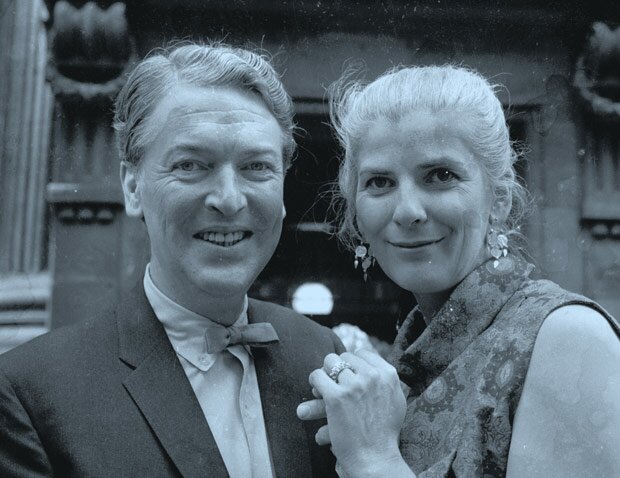
Photograph: Terry Disney/Getty images
To describe Kingsley Amis as a heavy drinker is akin to calling Picasso a painter and decorator. Amis raised drinking to an art form, a way of life, a means of engaging in conversation with those who knew him and drank with him. But in the course of 20 years’ heavy drinking with him in the later part of his life, I never saw him drunk. Drinking was something he did while talking and, sometimes but not always, while eating.
Ironically, we were introduced by his doctor, who was also my GP, at dinner at our doctor’s home. It was one of those evenings that began with Martinis, continued with fine wines and ended with a variety of stickies (sweet liqueurs) and a choice of interesting malts, Kingsley’s favourite tipples. Next day Kingsley had his annual check-up with the doctor who told him solemnly, as he did every time, that if he continued drinking like this he would be dead in a year.
In fact, it was the doctor who was dead a year later and Kingsley soldiered on with our doctor’s partner in the practice who delivered the same stern warning to Kingsley for the next 20 annual check-ups. Kingsley was still going strong when the doctor retired.
I was working in Fleet Street at the time, so three-hour lunches with Kingsley at Bertorelli’s or L’Etoile in Charlotte Street were not a problem. In those days, anyone returning to the office from lunch before 3pm or sober was regarded with suspicion and sometimes it was better not to go back to the office at all as few noticed and no one minded.
Around this time – I’m talking about the late 70s – I found myself temporarily homeless and Kingsley and his second wife Jane (the author Elizabeth Jane Howard) offered me a roof over my head at their lovely Georgian house in Barnet, called Lemmons. For Kingsley, the entire day (weekdays and weekends) was constructed around drinking – with a bit of writing before and after lunch.
In the pantry adjoining the kitchen where we ate there was a refrigerator stocked solely with bottles of Carlsberg Special Brew, with which Kingsley would begin the day before feeling well enough to pour himself a cup of English breakfast tea and butter his toast.
There were well-stocked drinks cupboards in all the downstairs rooms and half-way up the grand staircase was a two-tier table with a selection of bottles of gin, whisky and vodka and mixers. Kingsley explained that it was in case he ‘got caught short’ on his way up or down the stairs.
Most of all, Kingsley liked malt whiskies. Perversely, he mixed his own particular blend from a variety of his favourite malts that he decanted in a small wooden barrel in his study where he wrote. After dinner he would head for the barrel and turn on the tap but pour a glass only for himself – his family and friends would have to make do with one of the various trays of drinks in the evening room. This was no hardship for any of us.
For three months I became Kingsley’s drinking companion after work. It was a tougher assignment than my full-time employment as a Daily Mirror feature writer. When I arrived back at Lemmons after a day shift on the Mirror, Kingsley and I would retire to the local and down two or three pints of lager with whisky chasers. It was great fun. We would then return home for the serious night’s drinking – a Martini or G&T before dinner with wine, followed by a couple of malts before bed. It wasn’t long before I, too, needed to help myself to a Carlsberg Special Brew before breakfast.
About a month after leaving Lemmons, having completed the purchase of my own house, I woke up one morning and felt as though I had recovered from a serious illness. A twelve-week hangover, of which I had become unaware, had at last blown itself out. It caused me to address my own lifestyle for the first time.
Kingsley and I remained friends until his death many years later but met less frequently after I left Fleet Street and started my own business – which involved paying for my own lunches which, if I was lucky, consisted of a sandwich at my desk. Long lunches with friends and colleagues became a thing of the past and drinking relegated to the evenings. Kingsley struggled to understand this. “Drinking is not an occupation for part-timers or amateurs,” he said. “Are you sure you’re in the right job?”
Hot Buttered Rum v Hot Rum Cow
Sir Kingsley Amis was mildly dismissive of the Hot Rum Cow – the drink that we noticed in the index of his Everyday Drinking book and named this magazine after.
On pages 148-149, he describes a warm cocktail called a Hot Buttered Rum, adding: “If you cut out the butter and substitute milk for water you get a Hot Rum Cow. The Cow is going a bit far possibly but the Hot Buttered Rum itself seems to me a major compensation for the arrival of the cold weather.”
We haven’t tried a Hot Buttered Rum but a Hot Rum Cow – made with milk, dark rum, brown sugar, vanilla extract or nutmeg and angostura bitters – is a winter warmer we heartily recommend.

Enjoy this article?
This is an excerpt from Hot Rum Cow Issue 7 which is available to buy in our shop. Buy magazine