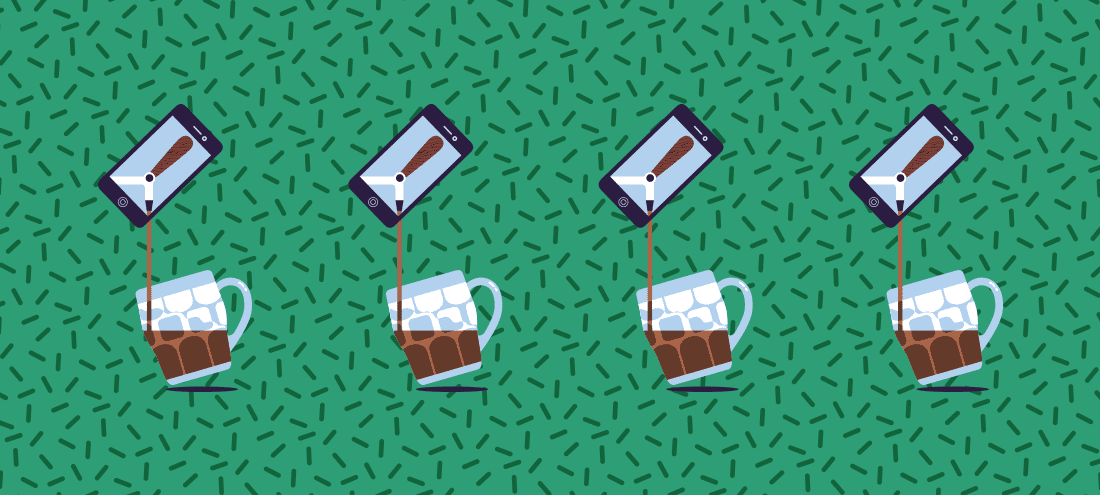
This is the future of boozing
Nine things to completely transform what, how and where you drink
“It is always wise to look ahead, but difficult to look further than you can see.”
When it comes to peering into the future, Winston Churchill certainly nailed the problem – predicting the future is a fool’s game. After all, who, 150 years ago, would have thought that respectable women could spend their evenings (and their earnings) in the pub, that brewing beer in the kitchen would be a popular middle-class hobby, or that 21st-century drinkers could order Sex On The Beach or a Slippery Nipple without being whisked away by the local constabulary? Yet while nothing is certain, nor is the future completely opaque, a number of research projects in and around the field of booze – and a handful of innovative trends – offer a tantalising sneak preview of where we may be heading.
Digital pubs (and drone deliveries)
There is no shortage of outlandish claims when it comes to predicting how the pubs of the future will be. Will our favourite drink be recorded on a microchip beneath our skin, sparing us from having to briefly speak to the bar staff? Will we be playing pool on tables constructed purely of light? Or be served beer from pumps which ‘brew’ to our individual preference on the spot? These are just three of the rather imaginative visions put forward by one ‘future trends analyst’ in 2009. Outlandish as they may be, it is reasonable to expect that the most traditional of establishments will need to adapt and embrace new technology in order to survive. For one, counting out your coppers on the bar in a befuddled state may soon be a thing of the past – last year, The Penbury Tavern in Hackney became the first British pub to accept payment in the digital currency of Bitcoins. And while self-brewing beer pumps seem unlikely, self-serving pumps are already with us. The Thirsty Bear in Blackfriars (operated by the rather creepy-sounding Robot Pub Group), is aiming to make queuing at the bar a thing of the past, with self-service beer pumps built into tables. The number of pints served is recorded by a tablet, which also enables customers to order food without going to the bar. All that is missing is a robot solution to ‘breaking the seal’.
With the widely publicised statistic of 18 pub closures a week in the UK, however, saving the local may, sadly, be beyond even robots. But that doesn’t mean they can’t still be of use. Until earlier this year, ice fishers in Minnesota were able to have beer from the local Lakemaid brewery delivered to their ice shacks by flying drones. Federal Aviation Authority killjoys have since stepped in and banned the service, but new legislation which may allow commercial drone flights may be ready by some time next year.
The end of the wine bottle
It’s been one of the most successful design solutions of the past 200 years – iconic, ubiquitous, synonymous with style and pleasure. But the future of the glass wine bottle looks uncertain. Richard Halstead, Chief of Operations at Wine Intelligence, believes that escalating costs of glass, fuel and transport are likely to eventually see the sun set on the glass bottle’s glorious career, with consumers and winemakers “much more interested in what’s in the bottle than what it looks like.” Among the alternative packaging waiting in the wings are plastic, pouches … and paper. Although still a novelty for now, paper bottles (complete with a plastic inner membrane) weigh 55g – around the weight of an egg – and have a significantly lower carbon footprint – 10% of a glass bottle, according to the manufacturer’s unverified claims.

Iconic, ubiquitous, synonymous with style and pleasure. But the future of the glass wine bottle looks uncertain
Aerosol cocktails
Liquid alcohol is so last millennium – in the future, you probably won’t even need to drink to get drunk. Powdered alcohol is already old news, first floated (or puffed?) in Germany and the Netherlands, with Subyou and the classily named Booz2Go, while across the Atlantic Palcohol is chomping at the bit for FDA reapproval – the US regulatory body having apparently waved the party powder through, before later reversing its decision.
If dry drinking isn’t your thing, however, how about vaporised booze? In 2012, Harvard professor David Edwards teamed up with designer Philippe Starck to produce WAHH Quantum Sensations, a pocket-sized alcohol aerosol. “We were interested in the idea of giving what we thought of at the time as a sort of instant and ephemeral pleasure that we associate with alcohol, but without any durable effects,” Edwards explains.
The WAHH works by converting just 80 microlitres of alcohol into a spray of tiny droplets which have the same collective surface area as a standard shot of spirit. Edwards claims that the first heady feeling of euphoria we get from a spirit is not from the alcohol we ingest, but rather from the vapour, which is absorbed directly into the blood stream through our lungs. And with its equivalent surface area, one squirt of the WAHH gives the same volume of vapour, and therefore the same momentary hit, as a shot. With just one thousandth of the alcohol, however, the effect lasts mere seconds. “It’s a very ephemeral, very real, physiological feeling of euphoria, but it doesn’t endure – and that’s the magic of it.”
It may sound like a gimmick, but Edwards is convinced that alcoholic aerosols are set to become a staple of future socialising and is blazing the way not only with the WAHH, but also Le Whaf – a stylised carafe that turns your cocktail into a cloud, which you then inhale through a straw. Perfect, he claims, for a cocktail party. “It’s beautiful, it’s fun, and it’s particularly good for things like Scotch and port – things that have a really strong taste. When you have a very ephemeral experience of them, you really do have a taste and some of the experience, but it’s just 1,000 times less powerful in terms of the effect on your body.”
“We were interested in the idea of giving what we thought of at the time as a sort of instant and ephemeral pleasure that we associate with alcohol, but without any durable effects,”
Edible packaging
Packaging is unlikely to set many pulses a-racing. But what if, after shaking out the last drop from your beer bottle, you were able to eat it? As bonkers as this idea sounds, there are people working on it. Earlier this year, designer Rodrigo García González unveiled his Ooho edible ‘bottle’ – a thin membrane, made partly from algae, which can be filled with water to form a little sack, or giant globule. The ‘bottle’ is 100% biodegradable and safe to eat. There are some teething problems yet to be addressed – the gelatinous Ooho cannot be resealed, is quite small, and looks like a used condom when empty. Yet where there is a will – and demand, and investment – there is a way, and work to refine the design is ongoing.
Edible containers could, in fact, become a staple of the drinks world, with jelly cup sensation Loliware trailing a blaze. This algae-based gelatine barware can be flavoured to complement your drink (only citrus and yuzu are currently available, but more are promised) and then either eaten whole or nervously nibbled at – making it both a convenient combination of beverage and bar snack, and the perfect prop for the socially awkward.

The end of alcoholism?
What if every newborn were screened at birth to determine their chances of developing alcoholism in later life? The dawn of affordable genomics means this could soon become a very real possibility.
It has long been argued that there is a genetic element to alcoholism. Cocktail-guzzling vervet monkeys, who have been known to raid bars on the Caribbean island of Saint Kitts, show eerily similar drinking habits to humans – a small number are teetotal, most drink moderately, 12% drink frequently, and 5% are unable to regulate their alcohol intake, mirroring almost exactly the percentages observed in human populations. Further evidence towards the influence of genes was provided by a 2013 study, carried out by researchers from five UK universities, which discovered a mutation which appears to cause alcohol cravings in mice, while it has also been observed that alcoholism often runs in families.
Now, as technology improves and becomes cheaper, gene sequencing looks set to become an integral part of preventative health care. The publicly funded Genomics England project aims to carry out whole genome sequencing of 100,000 people by 2017 and it has been suggested by former UK government advisor, and Imperial College London neuropsychopharmacologist Professor David Nutt that, within just 15 years, every British child will likely have their genome sequenced and recorded on a microchip implanted under the skin. In such a scenario, screening for alcoholism could be routine.
And for those for whom alcoholism screening comes too late, there may still be hope. A team of US researchers last year claimed that they were able to inject alcohol-addicted rats with a chemical which blocks neural pathways and ‘erases the memory’ of alcohol which triggered cravings, preventing a binge drinking relapse.
Sober pills
One of the more annoying consequences of drinking is the time lag between last drink and first sober thought and action. You may have decided to call it a night, but the party can go on in your bloodstream well into the next day. This inconvenience may soon be a thing of the past, however, thanks to a ‘sobering-up drug’ currently being developed by Chinese and US biologists. The drug is a package of enzymes contained in nanocapsules – tiny shells, too small to be seen by a conventional microscope, which can be injected into the bloodstream. One enzyme helps break alcohol down into the usual acetaldehyde, and also hydrogen peroxide; another breaks down hydrogen peroxide into harmless water and oxygen. A study showed that previously intoxicated mice who were injected with the sobering-up drug had significantly less alcohol in their system than their control peers. The researchers have likened the effect of the drug to having millions of liver cells in your stomach helping to digest the alcohol. Research is ongoing, raising the fantastic prospect in the not-too-distant future of a sobering-up pill.
A study showed that previously intoxicated mice who were injected with the sobering-up drug had significantly less alcohol in their system than their control peers
Synthetic alcohol
There’s no getting around it. As marvellous as many wines, beers and spirits are, alcohol has its downsides. But what if you could sidestep the ill effects with a new, ‘synthetic’ alcohol that gave you all the highs of a couple of drinks, without the lows? This Holy Grail of the party world may soon be with us, if the work of Professor Nutt bears fruit. Alcohol produces the sensations it does by working on different neuro-receptors in the brain. It is believed that only a couple of the receptors are responsible for making a drinker feel relaxed and happy, while the others, when stimulated, have less pleasant effects. Nutt’s research is focused on identifying chemicals which work only on the desired receptors, mimicking the pleasant effects of alcohol without the loss of balance, nausea, increased aggression, loss of memory, addiction, hangovers and general self-loathing. A product based on benzodiazepine, the drug from which Valium is derived, is under development, and there are even plans to create an antidote, so that takers could quickly sober up.
The dawn of ‘super barley’?
Imagine a future blighted by a world-wide whisky drought. This dystopian vision has, thankfully, become slightly less likely, thanks to a research project which aims to keep the distilling industry topped up with a new ‘super barley’.
Barley can be divided into two broad categories of winter and spring varieties. Spring barley produces greater quantities of spirit per kilo of grain, but winter barley produces more grain. The aim of the Impromalt project is to breed together the best of both to produce a variety with both high grain yield and high spirit yield, ultimately giving more whisky (and gin and vodka) from a smaller land area.
The process mimics the sexual breeding process which occurs in nature, but the researchers are able to use DNA and molecular technology to see precisely which varieties have the genes they are looking for, making the odds for a successful match much, much better. “If you look at the recommended list of barley varieties, you can make an astronomical number of possible combinations. You could take the world’s supply of barley, each year, and if you counted each grain as being unique you still wouldn’t exhaust all the genetic combinations,” explains Dr Bill Thomas of the James Hutton Institute in Aberdeen, which is leading the project. “If you just made an ordinary spring—winter barley cross, unless you were very lucky, you would lose a lot of the genes assembled to make a winter barley what it is today. But if we can precisely target just the individual regions which harbour the quality genes, then we preserve the essence of the winter barley genotype, but we improve its quality.”
The first of the super barleys are scheduled to be harvested in 2017. If successful, the project will help UK distillers both to meet demand and, since winter barley matures earlier and is therefore less vulnerable to late season droughts, to mitigate the possible effects of climate change.
“You could take the world’s supply of barley, each year, and if you counted each grain as being unique you still wouldn’t exhaust all the genetic combinations”
Robot sommeliers
You may well be able to envisage a future where robot waiters serve the wine. But what about one where robot sommeliers taste it for you? This is the dream of one research team at Washington State University, which has developed an ‘electronic tongue’ specially designed to sample wines. The ‘tongue’ is fitted with a series of biosensors which detect flavour compounds within the wine on a molecular level, to give an objective assessment of the wine’s quality. It is able to ‘taste’ a broad profile of sensory qualities, including sweet, bitter, savoury and metallic. The advantages are manifold: a robot sommelier’s palate never tires, it is not influenced by context, labels or price tags, it won’t get drunk, and will never be too embarrassed to tell a waiter that the wine is corked.


Enjoy this article?
This is an excerpt from Hot Rum Cow Issue 6 which is available to buy in our shop. Buy magazine