

Shaken, Stirred… or Spun?
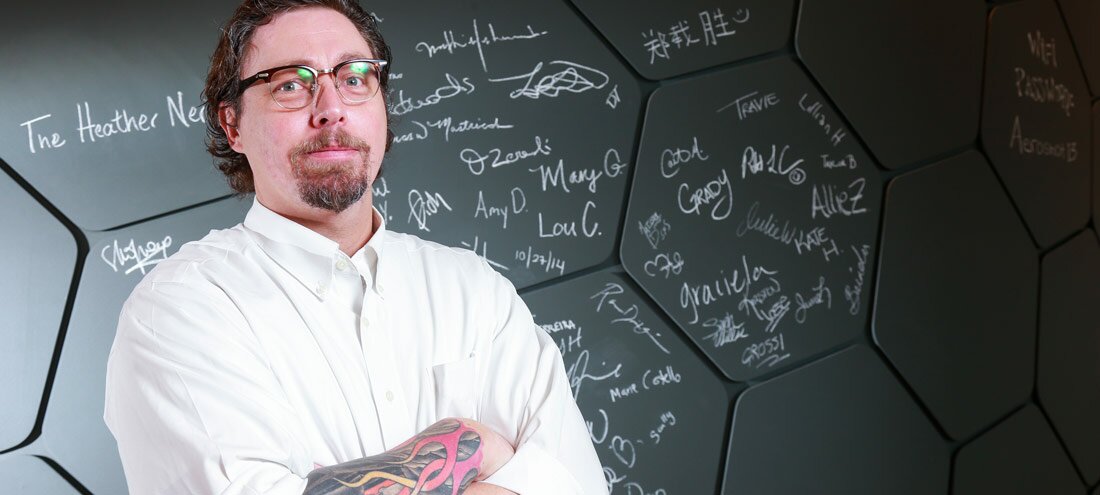
'Bar guy' Todd Maul brings a carpenter's eye to his cocktail creations at Boston's Café ArtScience
As well as retaining its status as a world-leading hub of academia, Boston, Massachusetts is now also home to some of the world’s most exciting gastronomic enterprises, attracting chefs, mixologists and scientists all fiercely intent on carving their own ivory towers. “Give me a hammer and a chisel,” says Todd Maul, however, “and I’m not going to make Michelangelo’s David. I’m simply here to make a better drink.” It’s an apt turn of phrase from an award-winning bartender whose pragmatic goal confounds many bartenders whom Maul claims “don’t know their asses from their elbows”. It’s even more apt, considering his previous occupation making furniture.
Much of Maul’s innovative approach is attributable to this experience. He says: “If you want to make a chair, you have to think about how you want the chair to look, and then you have to think about the joinery involved and how you’re going to put individual parts together, and then you have to think about how you’re going to make those parts into a final whole.”
This understanding of composition developed while studying at Boston’s North Bennet Street School, which specialises in manual craftsmanship. He had been mixing cocktails “like everybody else – making classics” for some time and realised the profound similarity between his two crafts. As a bartender he had been “looking at complete ideas that weren’t necessarily complete”, yet with compositional understanding and creativity he realised he could build cocktails the same way as furniture.
“Take a gin and tonic,” says Maul. “Your entire experience with it is gin, tonic, lime and ice, so what you have to do is understand each of the four components and how they go together. When you start to get into that mind-frame, you realise you can take components and compress them down to the smallest ideas, and then take those small ideas and move them around and change how you look at a drink.”
After graduating he worked in the bar at the renowned Clio in Boston where he met pastry chef, Renae Connolly. “We’d have these really wacky conversations about flavour. Soon I realised what I was doing wasn’t so far off what she was doing; she was very meticulous, and looked at things differently. She opened my eyes to another reality in gastronomy.”
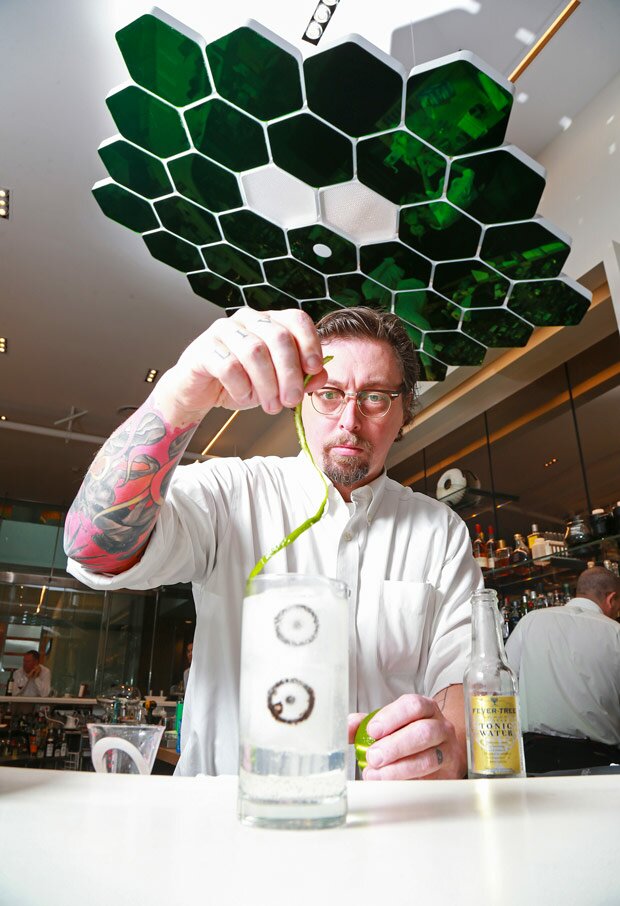
“I’m really into time release. I like the idea of a drink being like a story, with a beginning, middle and end”
Maul didn’t just bring a craftsman’s mentality and eye to his role; he also brought an affinity for power tools and scientific equipment. At Clio he invested in an arsenal of equipment, including a centrifuge, a rotational evaporator and a sugarcane extractor. But with so many pretentious bartenders around, he had to convince wary bar owners that what he was doing wasn’t ‘gimmicky’. He says: “I once met a bartender in Paris who told me he was going to buy a rotational evaporator, and he was talking as if he knew exactly how to use it. I told him he was talking complete shit. The first thing he had to do was stop talking to his bartending buddies who knew less than he did, find a scientist, ask him questions, then shut up and listen.”
For Maul the key was to become “the dumbest guy in the room”. He’d purchased his first centrifuge on eBay, and later got hold of his first rotational evaporator, which the head of chemistry from Boston University offered to help set up. “People run out and buy these seriously expensive machines, but they don’t know what they’re doing with them. I didn’t pretend to know everything, but I was willing to learn.”
Maul set to deconstructing cocktails and focusing on individual components. “Let’s look at limes. Everybody looks at limes the exact same way, but in actual fact they are very malleable. Instead of looking at them from a narrow-minded perspective I started looking at them like this: fresh squeezed lime juice lasts a day or two. Spin it out in a centrifuge and it lasts six more days, uses a product everybody’s throwing out, takes away the low acid note and makes a better drink. What’s not to love?” He also devised a method of reducing his now-clarified lime juice into a paint which he could smear inside cocktail glasses to help the look and taste. His take on the gin and tonic, too, incorporates his clarified lime juice where it’s used to rehydrate Middle Eastern black lime powder which is then injected into ice cubes. “When it comes to limes you’re looking at something which can be moved not just left and right, but up and down too,” he says.
This skewed perspective on cocktails soon brought another Bostonian to Maul’s door – Harvard Professor David Edwards, a biomedical engineer who’d been working for several years on various gastronomic inventions such as vaporised cocktails and edible packaging (see The future of boozing). “David contacted me and explained that people were calling me a ‘mad scientist’, and that he wanted to see if we could squash that. I said, ‘Listen, I have no qualms with any of that, but the last time I did chemistry was in 1985. I’m not a mad scientist. In fact, I’m not even a scientist. You’re a scientist.’ But after some conversations with him I realised that the kind of stuff I was starting to get into he already knew.”
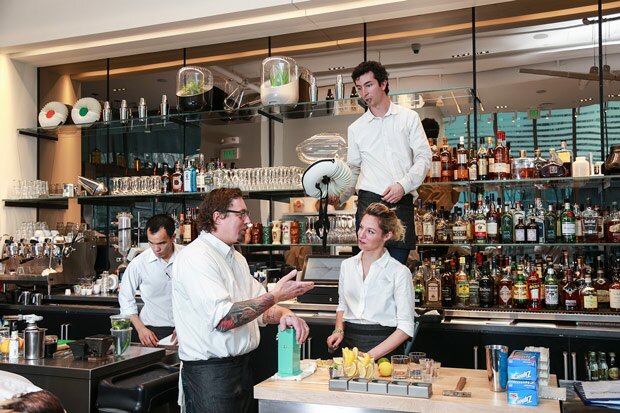
So began the collaboration which, along with restaurant manager Tom Mastricola and culinary artist Patrick Campbell, established the playground of molecular gastronomy that is Café ArtScience. It was the brainchild of Edwards who envisioned a no-boundaries think-tank cum restaurant in which people could experience food and drink from radically new perspectives. Edwards has brought his inventions and his outlook into the cafe, Campbell his flare for cuisine that is forward-thinking yet still contemporary, and Maul his unique approach to drinks. “I’m really lucky with the team I have here,” he says, “because it’s a group of people who allow things to happen organically. We’re getting into our own spaces now, and our own rhythms.” One thing the team has in common, however, is a commitment to making sure their enterprise is “purposeful” – something nowadays too often lost to pretence.
“Everybody’s writing these futuristic cocktail books at the moment, and a lot of people are trying to get in and around what we’re doing at Café ArtScience, but what most of these guys are saying or doing doesn’t pan out practically,” says Maul. One such example is the now-commonplace use of liquid nitrogen in cocktail making: “Liquid nitrogen chills a drink without diluting it, so you then have to add something like fruit juice which covers up the taste of the alcohol. You can’t consume a drink at that temperature either, so you end up sitting looking at something you can’t drink.”
Even something as simple as ice has become a cause of over-excitement amongst mixologists striving to produce the clearest possible ice by sourcing the purest water available. “How clear the ice is has nothing to do with the purity of the water at all,” Maul explains. “It’s about how slowly you cool it down and push out the oxygen. I could take sludge water and make perfectly clear ice cubes.” Instead, though, Maul approaches ice with pragmatism, favouring -40°C, blast-frozen cubes which chill and dilute drinks to the optimum degree.
His “purposeful” approach is also reflected in his garnishes: “Garnishes don’t need to be butchered-up fruit. When you squeeze a lemon into a drink you’re adding lemon juice, but when you zest it you’re adding the oil. They’re two different things and they should be treated as such.” Maul’s citrus paints exemplify this, whilst also introducing a fourth dimension to the cocktail experience: time.
“I’m really into time release,” he says. “I like the idea of a drink being like a story, with a beginning, middle and end.” As the lime paint at the bottom of one of his gin and tonics dissolves, so the drink changes flavour. His famous Todd Collins is even served with violet-infused ice cubes (much like his Middle Eastern black lime ice cubes) so that as they melt the drink changes colour in-hand.
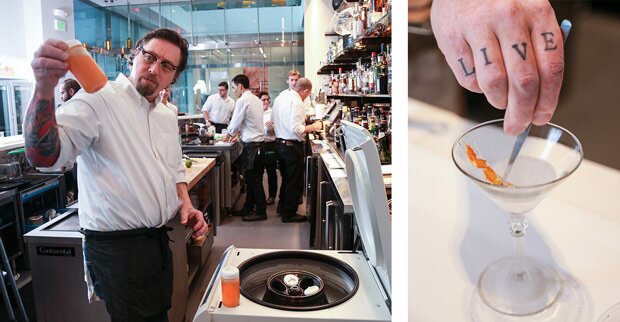
“People run out and buy these seriously expensive machines, but they don’t know what they’re doing with them. I didn’t pretend to know everything, but I was willing to learn.”
Edwards’ influence has extended behind the bar, most notably in Maul’s famed eggnog which is served with two eggnog ‘Wikis’ on the side. They’re edible spheres contained within complementary flavoured edible skins – white chocolate and vanilla with the eggnog. “You’re drinking eggnog through eating and finishing up with something to chew on which has a different flavour. That’s ridiculously cool.”
It’s at Café ArtScience that Maul has been able to fully prove the affinity between his craftsman’s past and cocktail making. “What we’re looking to do,” he explains, “is look at every part of the drink and examine it to the utmost extent.” Like Edwards, he’s tapping into the ephemeral experience that can be afforded through eating and drinking by manipulating individual ingredients to create drinks that have never before existed. Instead of throwing blue cheese stuffed olives into a cocktail, Maul has actually created a blue cheese vodka using his centrifuge. Similarly, you won’t find plain old bleached white sugar sitting at the bottom of his Ti Punch; rather, you’ll detect a grassy note which comes from fresh sugarcane juice, extracted using his sugarcane extractor, and which complements the Rhum Agricole like nothing else. “It’s like a jazz trio now as opposed to three fucking guys playing randomly in a speed-metal band,” he enthuses. His rotational evaporator plays a key role in manipulating people’s senses, as he deploys it to elongate notes much like a whammy bar on a guitar. “It’s all about making sure everything is playing in harmony.”
Despite Maul’s experimental practices and vision, he’s no mixologist. “There are really good doctors out there, but they don’t necessarily change their titles,” he says. “I’m just the ‘bar guy’ at Café ArtScience. I don’t believe in tips, and I’m not faking things to look cool like some people.” He’s the perfect man for a venue striving, above anything else, for purposefulness. “We view Café ArtScience as a place to come if your plans for Thursday night fall through, so that when you leave you’ll realise they didn’t actually fall through after all.”
Don’t expect, either, a night of nothing but out-there experimentation, for the team wants the venue to be somewhere that attracts regulars and newcomers alike looking for a mix of both new and familiar experiences. And if you don’t like the experience, then it’s down the sink on Maul and he’ll mix you something different. After all, his primary tenet remains his ultimate goal: to make a better drink.
Enjoy this article?
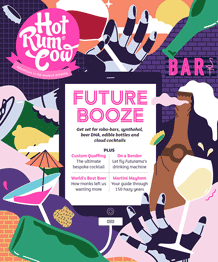
This is an excerpt from Hot Rum Cow Issue 6 which is available to buy in our shop. Buy magazine


Todd Maul,Tom Mastricola, Patrick Campbell, Renae (Herzog) Connolly and David Edwards have put together the most exciting new restaurant in the country, a true fact even considering my extraordinary level of prejudice. Cafe Art Science is NOT to be missed; More than worth fighting through the snow and cold for remarkable food and drink and desserts that will leave you crying for more.