The high tech world of America’s first Trappist brewery
In 1857 the first Trappist monks to set foot in North America appealed to their European brothers in their venture west of the Atlantic. 156 years later they made another appeal. This time, however, their mission was rather different
If you were to mistake the Spencer Brewery in Spencer, Massachusetts, for a branch of NASA, you’d be forgiven. State-of-the-art doesn’t quite do justice to this unabashedly sleek, 36,000ft2 modern brewery of German design and manufacture, capable of pushing out 50,000 barrels of beer a year. If you were inclined not to associate such a construction with people renowned for their simplistic and unassuming lifestyle, you’d be mistaken. “It’s a little oversized, certainly for what we’re producing at the moment,” explains the brewery’s director, Father Isaac, “and probably for what we’ll ever produce, but the idea was to allow us to brew whilst still working inside our monastic schedule.”
At the turn of the century the monks of St. Joseph’s Abbey addressed the problem of a decline in its monastic population which was threatening their very existence. They set out to establish a new enterprise that simultaneously accommodated existing monks and appealed to new ones, and all the while maintained their principle of self-sufficiency. In the end they returned to an art which Fr Isaac claims runs in their monastic genes: “We thought brewing would be a good activity for us. On the one hand it’s very traditional, and on the other there’s a lot of interest in speciality craft beer in America just now. What’s more, after speaking with our Belgian confrères we discovered that the brewing side of beer production is not actually all that labour intensive. All of these factors went into making the endeavour attractive.”
It may be true that the brewing process is not entirely labour intensive, but what must be considered is that the nine presently active and recognised European Trappist breweries have worked tirelessly for centuries to build the reputations they have today. Thus, the bar had clearly been raised for the monks of St. Joseph’s Abbey. “I think there was an appropriate sense of pride,” Fr Isaac says in relation to the International Trappist Association’s response to the initial proposal. “But when they realised what our intention was, and that we wanted to get them on board with this, and that we respected the reputation of Trappist breweries, they became more receptive. We weren’t looking to set up a flash-in-the-pan enterprise – we wanted to do it right.”
Undertaking a data-gathering mission, the monks visited all six active Belgian Trappist breweries. “When a man wants to become a monk,” says Fr Isaac, “he needs an older monk to guide him. Likewise, if you’re going to found a Trappist brewery, you’ll need those established in the trade to give you some advice.”
In due course they received the blessing of the abbot back at St. Joseph’s Abbey, and, thus equipped with knowledge of Trappist brewing, authentic Trappist recipes, permission to use genuine Trappist yeast and even an imported Belgian brewing engineer, the monks began their enterprise. The final building block was the brewery itself, and, as dictated by the International Trappist Association, it was to be nothing less than state-of-the-art. The Trappists maintain their position in world beer culture, they told Fr Isaac, because they all have these facilities. “We told them we understand why they’re saying that, and if that’s what’s needed – and if we can swing it – then that’s what we’ll do.” And in the end that’s exactly what they did.
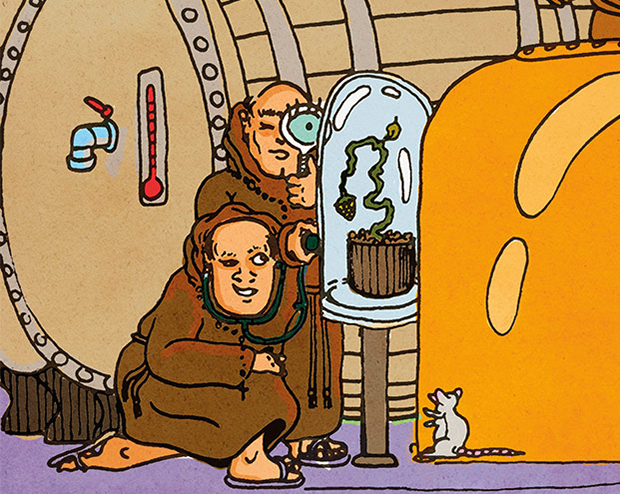
“When a man wants to become a monk he needs another monk to guide him. Likewise, if you’re going to found a Trappist brewery, you’re going to need established trappist breweries to give you advice”
It took the monks 24 pilot brews before they arrived at what is now Spencer Trappist Ale. It’s an ale inspired by the traditional refectory style, the type of ale savoured by monks in their refectories and favoured by Fr Isaac during his European tour. “Ordinarily a refectory ale would be between 4 and 5% ABV,” he says, “but we said if we’re going to put this on the market, people aren’t going to be happy with it, so we’re currently doing it at 6.5% ABV.”
Although clearly tapping into a European heritage, Fr Isaac is also keen to assert his product’s status as an “American” Trappist ale, the very first of its kind in the world. As such, the ingredients needed to be local: the malted barley – their ‘Spencer Mix’ – comes out of upstate New York, the speciality ‘caramunich’ malt out of Wisconsin, and the hops from the Yakima Valley in Washington state.
The water is even more closely sourced: “Underneath us,” says Fr Isaac, “is an ancient aquifer formed by the Laurentide Glacier 20,000 years ago.” Naturally, they built a well, and it so happened that the nutrient-rich water thus extracted proved highly supportive of their yeast culture. Even the colour needed to be genuinely local. As if describing the product of some alchemy, “It’s the colour of sunrise on Cape Cod in September when there’s a little mist on the ocean. What colour is that? It’s a beautiful colour. You really have to come and see it.”
Subsequent to a lecture on serving temperature, glassware and pouring method, Fr Isaac moves on to the taste, slowly explaining, “When it first meets your lips it has a nice crisp point of entry, and then it has two waves of flavour: one’s on the fruity side with a bit of apricot and mandarin orange, and one’s more spicy with peppery notes and some clove accents.” Fr Isaac clearly knows his stuff when it comes to brewing, and this is all the more intriguing considering the fact that he is only permitted to drink his product on Sundays and feast days. He’s hoping that Spencer Trappist Ale will soon rank alongside its older siblings in Europe. The brewery works in accordance with a neat business plan which sees a modest, progressive rollout: 4,000 barrels in year one rising to 10,000 barrels in year five. “The main focus, though, is to ensure that we have a good handle on quality,” he says, staying true to his monastic genes. “We’re growing a beer culture in the monastery and developing it – the monks are getting more sophisticated beer palates. But remember, we’re a monastery with a brewery, not the other way round.” And that will always be the case for St. Joseph’s Abbey.
There are preconceptions relating to the inhabitants of a Trappist monastery, substantiated by the fact that you’d be hard pushed to even spot a European Trappist monk, let alone converse with one; theirs is a cloistered life in the broadest sense of the word. It seems, though, that American Trappist monks adopt a rather different approach towards public relations. That is not to say that theirs is a less spiritually ‘focused’ cause – far from it. There is a sense that their willingness to commune with outsiders is rooted in a larger mission.
Monasteries have a long tradition of self-sufficiency, but for the monks of St. Joseph’s Abbey, the product of their self-sufficiency extends beyond the cloisters. “Our present little endeavour,” Fr Isaac modestly explains before departing for a television appearance, “is our way of offering something from the monastery’s table to the larger group of people who are interested in our way of life.” I get the impression that for Fr Isaac this is the most important aspect of the whole enterprise, and I’d be a fool not to accept his offer of hospitality at the table of St. Joseph’s Abbey soon.


Enjoy this article?
This is an excerpt from Hot Rum Cow Issue 7 which is available to buy in our shop. Buy magazine