It’s beer, it’s sport, it’s war
Hot Rum Cow examines national beers and sorts the fizz from the flat
Beer is a drink that can really stir up national sentiments. Being the primary booze of the masses, advertising has always played a key role in this, and sometimes it’s not so much palatability that proves a beer’s endurance, but semiotics; labels referencing historical golden moments, stirring victories and national symbols often prove big draws for beer companies.
The Thai beer Chang, for example, launched in 1998 not long after a disastrous Asian financial crisis and quickly became more popular than closest rival Singha thanks to a promotional campaign featuring local rock singer Aed Carabao singing about the beer, “Thais make themselves,” a move that appealed to the people during a time of insecurity. More recently, AB InBev tried to sweep the Russian market with its Siberian Crown lager by launching a Facebook page called ‘The Map of Russian Pride’, which contained statistics and patriotic stories designed to stir Russian drinkers’ love for their motherland. But what is it about beer specifically that makes it appealing for marketers trying to tap into national consciousness in this way?
Most mainstream brews spring from a shared brewing history, cater to the widest possible tastes and in many cases are sold by the same company. So, is there enough variety among these mass-appeal lagers to establish whose is the best? Never ones to shy away from a global dust-up, Hot Rum Cow brought together the most popular beers from 16 different countries around the world in order to resolve the debate with a world cup almost as lager-fuelled as the real thing. N.B. all drinks were drunk ‘blind’ to avoid any prejudices or preconceptions slipping in.
The First 16
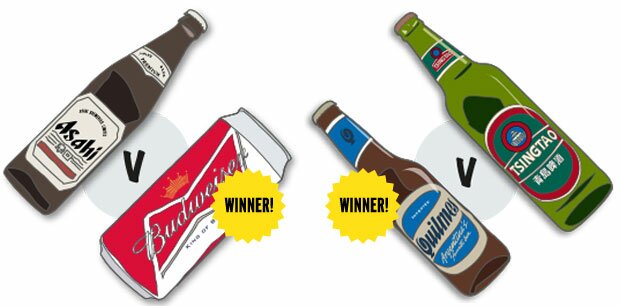
Match 1: Getting stuck in for our first round it was a cavalcade of malt mayhem from the kick-off. Round one pitted Asahi (Japan) against brewing superpower Budweiser (US). Without the shiny silver of its famous label to bowl us over, Asahi blew out in the first round, its ‘super dry’ styling having failed to impress our testers’ taste buds.
Match 2: A Sino-Latino clash for the ages, Quilmes (Argentina) vs Tsingtao (China) followed. Quilmes was perfectly quaffable stuff according to the panel, with something of a marzipan sweetness tickling the tongue. Tsingtao was palatable still, but notably light, with a thinner head when compared with the Quilmes, which pipped this one by virtue of tasting like home baking.
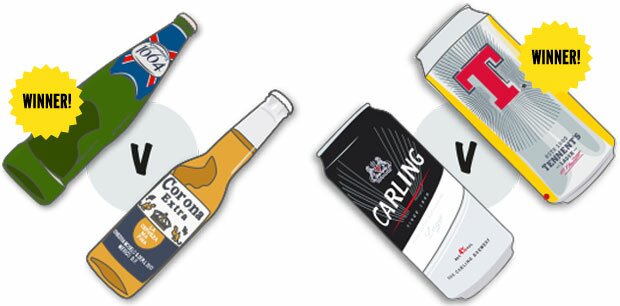
>Match 3: Kronenbourg (France) against Corona (Mexico) was the André the Giant-meets-Rey Mysterio match-up we never knew we wanted. Corona waded in with a cheeky backhand slap, but it couldn’t get André 1664 against the ropes, such was his tremendous body. Better luck next time, CoReyna.
Match 4: Carling (England) charged across our tongues like a rampaging cavalry unit, set to strike against the plucky upstart Tennent’s (Scotland) with behinds still bared to the air, kilts flapping in the wind in defiance. Eschewing Scotland’s usual plucky losers label, Tennent’s just edged it in a tight contest.
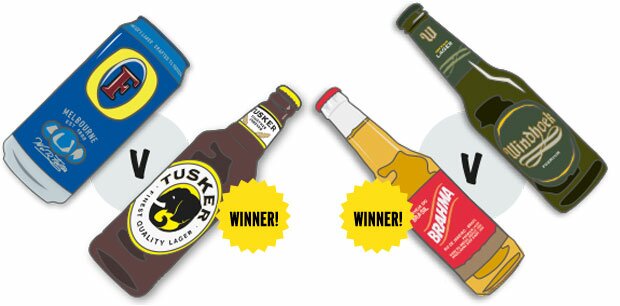
Match 5: Tusker (Kenya) delivered a big barley hit to our testers’ chops, laying out watery rival Fosters (Australia) in one fell blow like a headbanging elephant. Fosters tried to bounce back with the ferociousness of a kangaroo cliché, but wasn’t up to the challenge. Tusker was by far the more interesting lager; a clear winner.
Match 6: Brahma (Brazil) took on Windhoek (Namibia) as the tasting session descended into a stealth geography quiz. By this round our once keen sense for the sapid was rapidly dilapidating. Formerly enthusiastic tasting notes (hints of ashen earth, glazed turnip and the breath of old lovers), had given way to insights like “A bit fruity!” (Brahma) and “Hoppy!” (Windhoek). This is getting difficult. Brahma sambaed on.
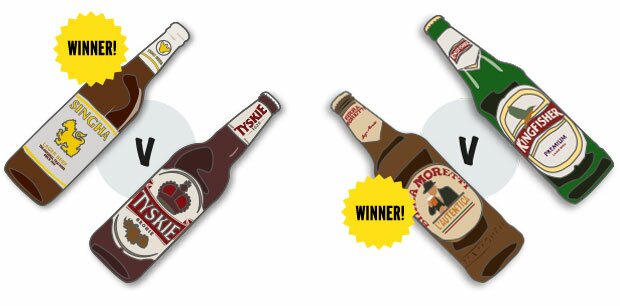
Match 7: A face-off between two lagers that are arguably the most commonly mispronounced, Singha (Thailand) vs Tyskie (Poland) was a tight contest. Thailand and Poland have never had much of a beer beef. Until now. We rattled and sloshed these amber assailants around our mouths with purpose, with Singha winning out in the end thanks to its rich, clean hoppiness.
Match 8: Kingfisher (India) and Birra Moretti (Italy) brought two distinct styles to the competition: the former dark with a lingering aftertaste and the latter light and crisp, with a head big enough to put Zardoz to shame. In the end though, Italy pipped it with its cheeky charms.
The Quarter-Finals
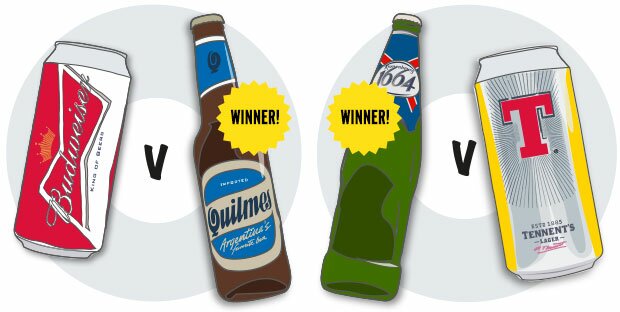
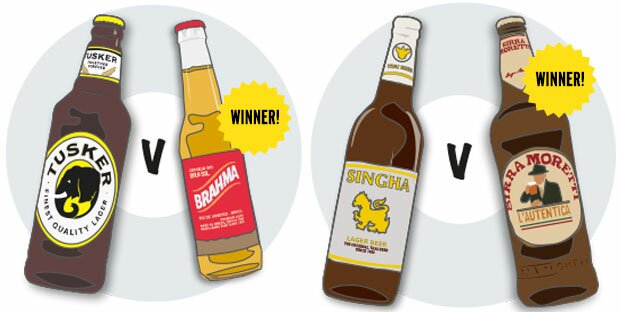
It was North America vs South America when Budweiser took on Quilmes in the first of our quarter-finals. Underdog Quilmes, brewed German-style in keeping with emigrant founder Otto Bemberg’s techniques, beat Bud for taste outright. The Auld Alliance was torn asunder for the match-up between Tennent’s and Kronenbourg 1664 meanwhile, as the French brew saw les Écossais blown away with the cold calculation of a Gallic gust up a shy Scot’s kilt. Brahma beat Tusker in a close match, our tasters deciding that in the end “different” just wasn’t enough to see it through, while Birra Moretti won against Singha, which fell flat in close-quarters combat.
The Semi-Finals
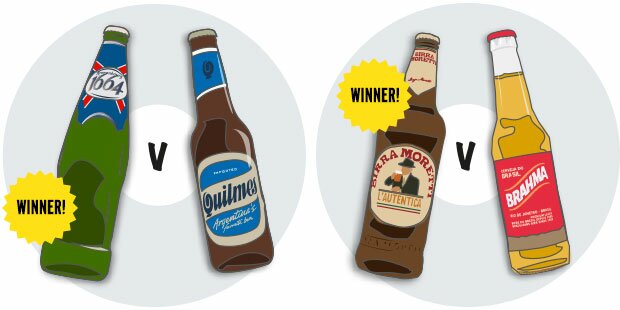
Down to the semis and France’s Kronenbourg 1664, displaying a consistency not often associated with French sporting teams, put in a strong performance against Argentina’s Quilmes. Brahma vs Birra Moretti meanwhile ended up in a victory for the Italian Stallions. Sorry Brazil, but there’s no room for lightweight beer sans Neymar in this competition. Sorry, I meant ‘any more’ in this competition (slip of the keys).
The Final
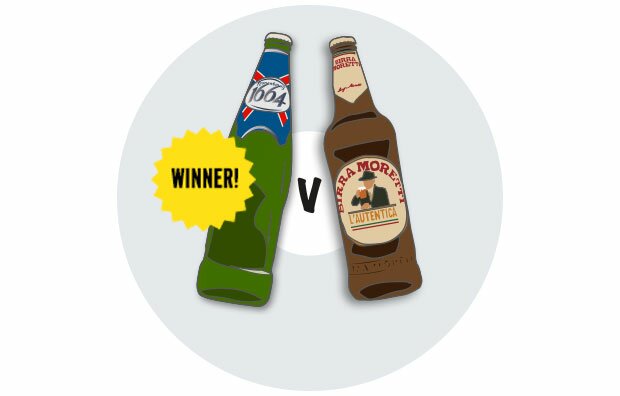
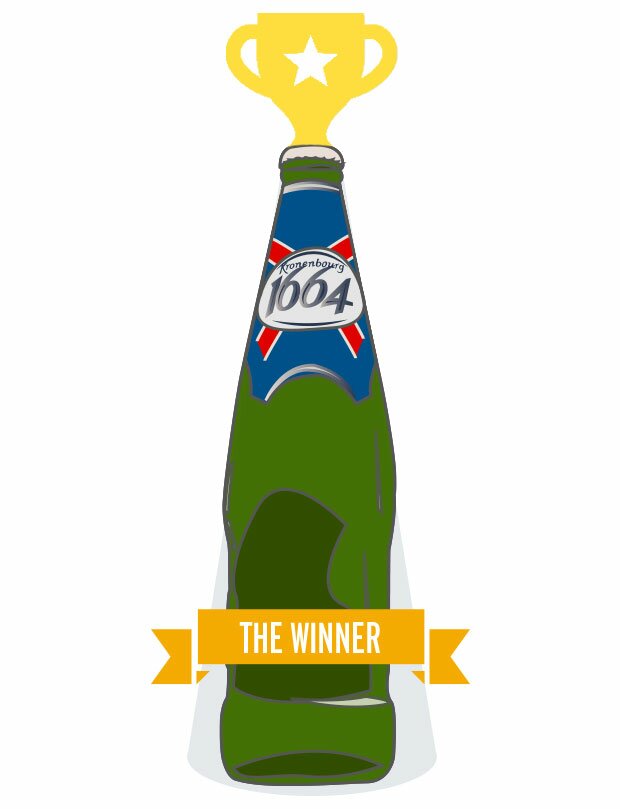
The final of the inaugural Hot Rum Cow Beer World Cup represented the inarguable crème de la crème of the supermarket shelf, and it came to a bloody showdown of those two great romantics, France and Italy. It was a close-fought final indeed, and our testers were torn, but in the end Kronenbourg 1664 pipped it by a single vote. Overall then, a surprising winner perhaps, but the French brew was held afloat in the end as a genuine top-tier tipple. Vive la France!