
Aquavit – hail to the eternal king of Nordic nips
From the frozen north to the Equator and back again as we take to the Golden Road in search of Scandinavian aquavit
From their framed vantage point on the wall, the august black and white faces of a bygone king and queen watch over proceedings in earnest as a glass is poured. Gurli Riis Holmen, my beamish host decked out in a red and white polka dot dress, takes a small step back in anticipation as I sniff and inhale the potent vapours swirling up the inside of the glass.
Despite having a palate used to deciphering the notes of a single malt whisky, the nail polish aroma wafting from the amber liquor gives nothing away as I prepare for my first taste of aquavit.
It glides over my tongue, yielding nothing besides the burn of alcohol. That is until a blast of aniseed and spice catches me off guard and sends a tsunami of heat to my stomach and extremities. Like signals down a telegraph wire, the nerves in my head and shoulders react and shake me into a hard shudder like a wet dog. Riis Holmen emits a raucous belly-laugh in approval. “Do you like it?” It’s a rhetorical question no doubt but I politely nod and chase it – as is the custom – with a beer.
Distilled in Norway, Denmark and Sweden, aquavit is part of a shared culture across the Nordic states and is as synonymous as whisky is to Scotland. With a grain or potato spirit as its base, the distillate is traditionally spiced in a pot still with caraway or dill with aniseed, fennel, star anise and coriander (amongst other things) according to recipes handed down over the centuries. Although it is produced across Scandinavia using similar techniques, the Norwegians, it has to be said, have taken the heritage of aquavit particularly seriously and nowhere more so than here in central Norway.

My voyage of discovery brings me to Trondheim, a small city intrinsically linked to the Norwegians’ fierce sense of national identity and, some would say, where its feisty national tipple first caught on. Not far from where I sit with my aquavit lies the imposing gothic cathedral, Nidaros. The most northern medieval cathedral in the world, it is said to be the final resting place of the country’s patron saint and ‘eternal king’, Olaf II – a romanticised 11th-century warrior monarch who united the people in Christianity before meeting a grisly end in battle.
As with all of our alcoholic vices, aquavit is closely associated with men of the cloth. The first mention of aquavit – or akevit in Norwegian – was in 1531 when Olav Engelbrektsson, the Archbishop of Nidaros, requested a shipment of aqua vitae. Billed as the wonder drug of the age – a universal cure for all ailments – its widespread use as a medicine was credited by many to the cleric, and so began the aquavit obsession.
As a Dane living in Trondheim, Riis Holmen is well versed in aquavit from all over Scandinavia and keeps the café well stocked with a phenomenal 111 varieties. Loquacious in her mother tongue with a fetish for vintage kitsch, she has made waves with Baklandet Skydsstation – the café I’m sitting in. In its opening week, queues stemmed out of the door and up the cobbled street, if not just for its culinary wares and aquavit but also to soak up its historical character and off-the-wall quirks.
An old stove, like a doric pillar of black metal, sits unlit in the corner of a room festooned with royal memorabilia of the current king, Harald and wife Sonja, while next door, strips of crocheted Fair Isle-style patterns adorn the walls like swatches of jumper material for Detective Inspector Sarah Lund from The Killing.
The eccentric café is one of the best-preserved buildings of its kind in Trondheim’s Gamle Bybro (old town). With its traditional wood-clad exterior and its oddly constructed walls and floors at acute angles, this cosy spot was originally built in 1791 and over the centuries has had various incarnations: a millinery, dairy, carpenter’s workshop and launderette. Riis Holmen, passionate in her fervour for aquavit, has brought the café almost full circle to its original purpose as a tavern. In the early 1800s, when there was a toll to enter the market in the Gamle Bybro, the farmers from the outlying countryside would tie up their horses outside Skydsstation and spend their toll money on something more sensible – drams of aquavit.
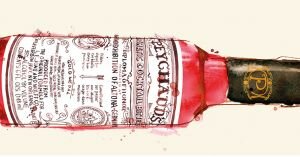
As I tuck into a smorgasbord of cured and fried herring (served no less in fish-shaped dishes which I have no doubt would have been pitch-perfect at a dinner party in 1965), Riis Holmen arrives back at the table gleefully brandishing another bottle. She has one that she is desperate for me to try: a robust, sherried Lysholm Linie aquavit.

It was a balmy, humid day when the MV Tonsberg docked in Singapore. With clear skies and the mercury hitting 26°C, it would have been a marked improvement on the mild, overcast autumn day at its previous port of call in Sydney. Or the bitter minus 7-degree conditions when the ship berthed in Boston before that. On board, somewhere in the hold of the gargantuan cargo vessel, was the Linie aquavit now swishing in the bottom of my glass in Trondheim.
Linie is the only spirit in the world matured at sea. Far from being a gimmick, it travels across the equator twice maturing in sherry casks as part of a tradition that dates back over two hundred years. Embarking on a trade mission in 1805, a brig named Trondhjems Prøve set out from Trondheim to Indonesia charged with fish, ham, cheese and casks of potato liquor for sale. Having failed to offload the spirit, the captain had no choice but to return to Trondheim with it, arriving back in 1807.
Once the cargo of spirit was disembarked, the casks were opened and the liquor shared out amongst the crew. To their great surprise, the spirit had greatly improved in flavour after two years at sea and was smoother and extremely palatable. And so, Linie aquavit was born.
I have to say, the dram is decidedly more rounded, slightly sweeter and more aromatic than the last Riis Holmen served. While methods have vastly improved since 1807, every drop of Linie continues to be shipped as deck cargo where the changes of temperature, humidity and rolling movement are still said to enhance its maturation.
In this spirit of adventure, Riis Holmen tells me to look at the inside of the label where I find the name of the Wihl. Wilhelmsen ship and the dates when this particular batch of aquavit sailed inscribed.
Several excellent drams and herring dishes later, as I walk through the city past remnants of dry docks and the historic, multicoloured wharves on stilts in the Nidelva river, I realise there is little evidence of the aquavit trade left. So what happened? The trail seems to go as cold as the chilly spring breeze that hits me as I leave the café.
Two hours by train, spirited along the banks of the inner Trondheimsfjord, brings me to Inderøy. A rural peninsula north of Trondheim, it’s here that I’m told I’ll find the country’s oldest distillery.
“This is what we call the ‘Golden Road’,” says local Anne Haga. Sounding more like something from The Wizard of Oz, it soon becomes apparent what she means as we drive through picture postcard scenes of furrowed land dotted with church steeples and white-washed farmsteads and pasture that slopes off down to the fjord’s edge. With some of Norway’s most important producers calling these parts home, including dairies that supply the royal palaces and some of the first wave of craft brewers to open in the country, the ‘Golden Road’ seems like a natural choice for the early distillers to move to from Trondheim.
Jolting about in her van towards the small town of Straumen, Anne points out that it is here in the fields either side of the undulating country road we’re bounding along that many of the raw materials that go into Norwegian aquavit take root: potatoes and caraway seeds.
The arrival of the potato in Norway in the 19th century helped Norwegian aquavit secure distinction from its Swedish and Danish grain-based cousins. It also revolutionised its production since the country traditionally suffered regular crop failures. “It is easier to make the potato grow here in Norway,” says Haga, “so that’s why grain was pushed aside for aquavit. It’s only Norway which has kept potato liquor.” It is with no small irony that the potato has become known in these parts as ‘the grape of Scandinavia’.
Cheap to produce with a four-times higher yield, the putrid perfume of boiled potatoes was commonplace. Distillation at the time was commonly seen as a female occupation so it fell to women and their daughters to distil the liquor on farms, often using primitive stills and apparatus. The taste would have been bitter and of poor quality, too. It was at this point that the experimentation with different spices, herbs and botanicals first began to mask its taste.
The arrival of the potato in Norway in the 19th century helped Norwegian aquavit secure distinction from its Swedish and Danish grain-based cousins
On the outskirts of Straumen, mere paces from the fjord shore, we pull up outside Sundnes Brænderi. Built in 1843, it continues to distil 80% of the potato spirit used in aquavit production although in the last few decades, it has done so alongside producing potato foodstuffs for supermarkets.
Still, peeling back the layers of its history with distillery manager Jan-Henning Johanssen reveals some of the romance of its former glories. It was bought in 1844 by a Swede named Andreas Mattson, who moved his distillery from Trondheim to Sundnes, which in turn enjoyed a long and fruitful period under various owners, including the most famous distillers, Jørgen B. Lysholm.
“It was destroyed by a fire in 1900 before it was rebuilt,” explains Johanssen as he gestures to the still house – a tall red-brick building with a banana-yellow cladding. A faint hum melts away into a deafening cacophony of mechanical white noise as we open the stillroom door and step inside. Amid heat and a smell not too dissimilar to roast potatoes, the production staff are busy processing a mash through their patent stills with just some of the 550,000 litres produced on site each year trickling down into the spirit safe.
In 1919, the manner in which aquavit was distilled changed forever at the ballot box when a referendum to prohibit alcohol passed overwhelmingly. “It was a problem. People were drinking too much,” Haga laughs. “It was prohibited to produce liquor from 1920 up until 1924 when they regulated the production of alcohol.”
Of course, like prohibition in the United States, the law did not stop people making their own moonshine with illicit stills; aquavit – albeit of poorer quality – was still being churned out in barns and cellars the length and breadth of Norway. In 1924, the government set up Vinmonopolet – a state-owned monopoly which acquired each distillery, one by one. A second referendum in 1926 overturned prohibition; by this time the industry had been changed beyond recognition.
Today, Arcus – which until recently was part of the state monopoly – produces all of Norway’s aquavit. Taking distillate from Sundnes, the state-run company infuses it according to old recipes before maturing it in oak casks for at least six months. “They took all the recipes from all the distilleries in Norway,” says Anne, “which is why the master at Arcus is the only guy with control today.”
It seems like an inglorious end to a glorious history, but aquavit is thriving as much now as it ever was. Leaving Sundnes behind, the train back to the bright lights of suburbia beckons and without doubt, so does another dram – or a “Jørgen B.” as it’s affectionately known – with Riis Holmen.

Enjoy this article?
This is an excerpt from Hot Rum Cow Issue 8 which is available to buy in our shop. Buy magazine



Leave your comment