Old fashioned spontaneity
What does it take to brew Lambic - Belgium’s strangest beer?
The beer writer Jacques De Keersmaecker has described Lambic beer as ‘a living anachronism’, and with good reason. While other contemporary commercial beers are fermented with specially harvested yeasts pitched in controlled conditions, Lambic is unique in preserving the pre-industrial practice of spontaneous fermentation.
It belongs to a world that no longer exists, where a brewer could trust that the fermenting of beer, like the rising of the sun every morning or the coming of spring, would just happen, without needing to understand why. The result, according to the late beer guru Michael Jackson, is “the most unusual style of beer made in the developed world” — in fact, hardly like a beer at all. Almost flat and often associated with a slight tang, a good Lambic should, Jackson notes in his World Guide to Beer, be “variously reminiscent of a fine dry cider, a Chardonnay or a Fino sherry”.
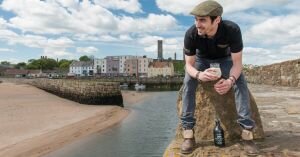
Having taken over the last Lambic brewery in the historic town of Lembeek in the 1970s, Frank Boon has been brewing the style for almost 40 years. From an initial annual production of 250 hectolitres, Boon has, over the years, increased the brewery’s output to 14,000 hectolitres, making him, he claims, Belgium’s biggest brewer of traditional Lambic. In that time he has seen Lambic beer go from obscure local thirst quencher to darling of the gastropub and Belgian national icon. But it hasn’t always been easy. “It was my aim to be a small brewer and to live from it, to have a nice time and to only have to work four days in the week,” he recalls. “But I discovered that I had to work seven days in the week and that I had to swim, to swim, to swim, not to go to the bottom of the lake with my brewery.” So, he is well placed to talk about the joys, trials and tribulations of brewing Lambic.
Lambic is the oddball of the beer world for a number of reasons. Firstly, it is made from 35 per cent unmalted wheat, instead of the 100 per cent malted barley more typically used to brew ales and lagers. It lacks the mouth-pinching hoppy bitterness typical of so many contemporary beers, since aged rather than fresh hops are used, giving subtler nuances of flavour (sometimes akin to a muscat wine, Boon claims). It also requires a bit more patience than most beers — while an ale or lager can be fermented in a few weeks, Lambic fermentation can take months or years. This takes place in wooden casks, some of which may have previously been used to store port, red wine and, yes, sherry. Moreover, in its most common commercial form, the ‘gueuze’, Lambic is a blended beer, crafted from a mix of older and younger ‘vintages’ and then refermented in bottle. What marks Lambic out from other beers more than anything else, however, is spontaneous fermentation.
“Do you think, when you cook at home, that if you switch to coal that you will make better dishes? That it will be finer? It will create an atmosphere, certainly, that’s how my grandmum did, but that’s not how you make the best dishes”
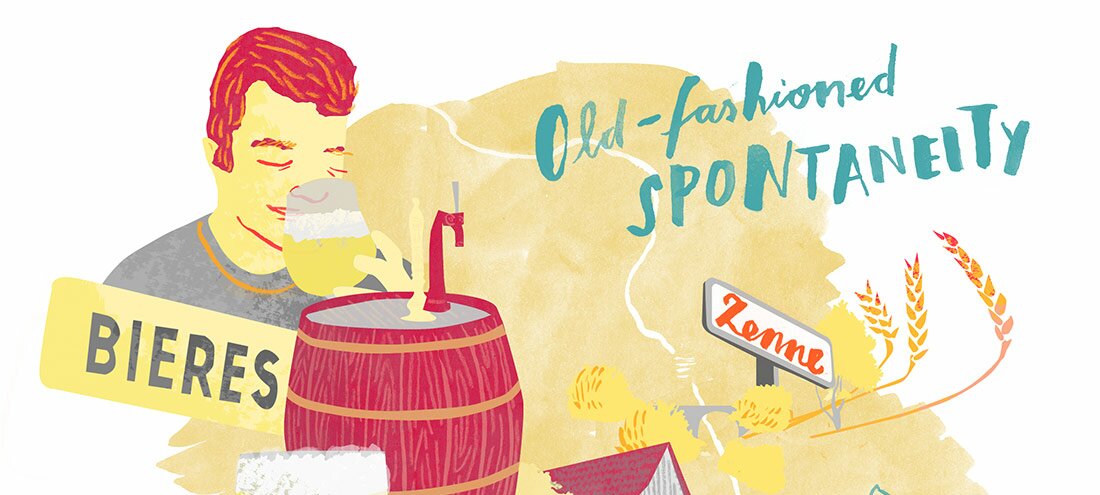
This, according to Frank Boon, is what makes it “one of the easiest and also the most difficult of beers to make”, and what continues to fascinate beer lovers around the world. The process of starting the spontaneous fermentation of Lambic beer is, indeed, deceptively simple. As the evening air drifts into the brewery through a series of open slats in the roof, freshly mashed wort is poured into a large shallow tray (the ‘coolship’) and allowed to cool. After just one night of being exposed in this way, the wort will be inoculated with all the yeast it needs to make the perfect Lambic. However, there are around 1,500 different known species of yeast, of which only a small number are helpful in the beer-making process.
Many more, not to mention the swarms of naturally occurring air-borne bacteria, may ruin a brew. Wort left out to the mercy of the outside air is therefore extremely vulnerable. To make things more complicated, some microorganisms that are more often the scourge of brewers — strains of the Brettanomyces yeast species, commonly responsible for off-flavours in wines and ales, and acid-producing bacteria — are actually required in Lambic to give it its characteristic complexity. On the other hand, too much bacteria will result in sourness, which, contrary to popular opinion, is not the point of a Lambic beer. “Of course, you get some sourness — it’s part of the taste — but it is not the focus. It’s the rich taste you get from wild yeasts that is the most important,” Boon explains. Instead, a good Lambic should, he says, “be something with the alcohol content of a beer, the taste of a white wine, and the phenolic smoky side of a whisky.”
The challenge for the Lambic brewer is to somehow regulate the local environment to ensure he or she gets exactly the right balance of microorganisms — which is clearly easier said than done. After all, “You cannot put someone at the window to say, ‘you can enter, you cannot’. You have to take the air like it comes inside, with all the bugs.”
Since yeast and bacteria hang in the air and cling invisibly to every surface, the only way to influence them is to control the brewing environment. Inside the brewery this means paying attention to, for example, the dimensions of the coolship, and the way and extent to which it is cleaned. But the outside environment is equally important, in particular the temperature and humidity of the air — too warm means too much bacteria; too dry means too little yeast. For this reason Lambic can only be brewed during the evening and during the cooler months, typically from October through to April. The precise location of the brewery is also crucial, with the optimal position being close to a river in a valley, to ensure more humidity. It’s no coincidence that Lambic breweries have traditionally clustered along the Zenne river.
Location, in fact, is an interesting and moot point. For all their skill, Lambic brewers rely on the unique cocktail of microorganisms found naturally in their local environment (and which varies from brewery to brewery). The beer is only ever brewed in an area of around 500km2, to the south-west of Brussels. Could a Lambic beer be brewed elsewhere? In theory it ought to be possible and there have certainly been attempts. But in practice the vast majority of ‘Lambic-style’ ales, or ‘sour ales’ in production today are not spontaneously fermented and rely instead on the deliberate addition of Lactobacillus to produce the acidic tang. Frank Boon says he keeps an open mind on the issue, but has a salutary tale that suggests otherwise. “[In the next village] they tried to make Lambic many years ago, but they always had beer overgrown by bacteria, with no fine taste and impossible to sell. It’s a question of three or four kilometres – and it is on the Zenne.”

It’s little wonder that other villages and other lands might covet Belgium’s strangest beer — while the style was out of favour in the 1970s when Boon first ventured into Lambic brewing, it is now appreciated as a unique and complex drink, prized by cultural historians and salivated over by beer nerds. But the same quirks and idiosyncrasies that lend it its appeal also threaten its survival, now as 40 years ago.
Back then, Michael Jackson described the traditional Lambic brewhouses as “tiny gems of industrial archaeology”, some of them adapted from old farms or village cafes. While fascinating for the interested tourist, it’s a set-up hopelessly inadequate for the demands of a modern brewery. A necessarily laissez-faire attitude to microbacteria is also difficult to square with contemporary health and safety regulations, as Boon discovered to his cost around 10 years ago, when the Belgian authorities obliged him to wash his brewery down with chlorine. The bleach destroyed the resident wild yeasts and the beer became overrun with bacteria. “If you have a nice garden with nice flowers and you disinfect it with chlorine, there’s nothing left of your flowers either. It’s the same,” he laments. He has since reached a compromise with the authorities, agreeing to wash his premises with water only, and to paint it regularly, but only one wall at a time.
But the even greater challenge for the contemporary Lambic brewer, perhaps the greatest threat to the beer’s survival, is the economics of brewing. Here, commercial success is unfortunately a question of quantity as well as quality. It’s not that there is a lack of interest — to the contrary, Brouwerij Boon has struggled in recent years to keep up with demand. Instead it is a question of cold business realities, with small, artisan production and the long periods of time necessary for fermentation not conducive to the high turnover and economies of scale on which commercial breweries build their growth. Jacques De Keersmaecker notes that the output of all Lambic breweries combined is around 370,000 hectolitres a year. Lindemans, the biggest single producer, accounts for around 85,000 of those. The Boston Beer Company, in contrast, which produces the Samuel Adams brand and is only the 10th largest brewer in the US, has an output of around 1.1 million hectolitres a year.
To solve the problem, in April of this year a new Brouwerij Boon opened, equipped to satisfy health and safety requirements and with a vastly increased capacity of 14,000 hectolitres – up from an original 250 hectolitres from the old De Vits brewery. The old coolship has been retained, and the beer continues to be fermented in wooden casks, but can the spirit, not to mention the flavour, of a true Lambic be preserved in a 21st-century brewing environment? It might not be the quaint curiosity that Michael Jackson described back in 1977, but this Lambic brewer is unrepentant: “Do you think, when you cook at home, that if you switch to coal that you will make better dishes? That it will be finer? It will create an atmosphere, certainly, that’s how my grandmum did, but that’s not how you make the best dishes.”
Enjoy this article?
This is an excerpt from Hot Rum Cow Issue 4 which is available to buy in our shop. Buy magazine