

Toro Terrífico
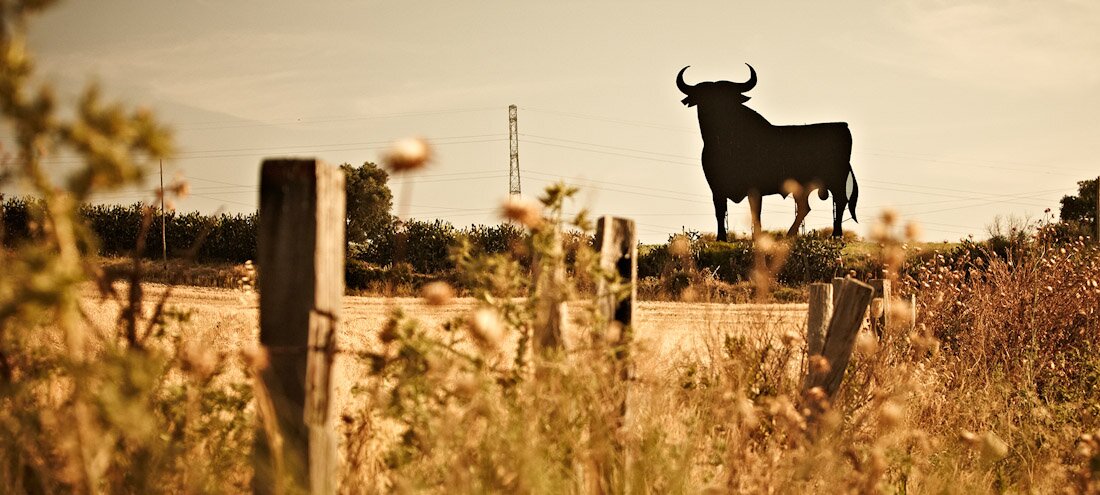
Superimposed on the skyline, their silhouettes stand proud all over the Spanish countryside. At first glance, when obscured by fields of sunflowers or looming from behind hills, Osborne Bulls can appear real. But with a proper sense of perspective their scale gives them away as billboards – or ‘bullboards’, as they are known
T
hese hulking beasts have become synonymous with Spain and cherished by its people, but what many don’t realise is that they began life as an advert commissioned by the sherry company, Osborne, to promote its Veterano brandy.
The Osborne Bull was born in 1956, conceived by artist Manuel Prieto, whose simple outline, scribbled on a scrap piece of paper, can still be viewed today at the Osborne bodega in El Puerto de Santa María. Prieto appropriated what was already a potent, mythological image within Spain and throughout Europe. The bull is such a powerful symbol that even Franco’s fascist regime tried to adopt it as its own, despite it being created by a known communist.
“Europe is named after Europa, who was the mortal woman raped by Zeus when he was in the guise of a bull,” explains Dr Carla Johnson, Emerita Professor of Saint Mary’s College Notre Dame and an expert in advertising. “It’s especially powerful as a symbol in Europe, but nowhere more than in Spain. It’s been in their character from the beginning.”
The Osborne Bull embodies, above all, strength, virility and masculinity, accentuated by the bull’s overt testicle, an audacious addition by Prieto for the time. In Bigas Luna’s acclaimed film, Jamón, Jamón, young starlets Penélope Cruz and Javier Bardem consummate their relationship beneath the bull’s silhouette, a tradition reputedly still continued by young Spanish couples.
“Of course, the Spanish are very proud especially about masculinity,” says Johnson. “There is an ideal between the Spanish man’s life and the life of the bull. It has to do with living well and not working too hard. The bulls aren’t required to do any work until their moment of grandeur. The bull is a perfect icon to connect with sherry, because it is representative of a good life.”
Around 500 bulls were built, initially of wooden panels and then from the 1960s onwards made of metal. Made in El Puerto de Santa María by the Tejada family for three generations now, the bulls remain magnificent feats of engineering; weighing nearly 9,000lb and standing at 45 feet high, they are a jigsaw puzzle of 70 pieces of thick, black iron assembled with 1,000 bolts. Referring to them as billboards does not seem to do them justice.
The bulls were taken to the hearts of a nation as it became increasingly motorised. Drivers eagerly anticipated seeing the imposing creatures and 90 bulls still stand watch over Spain’s highways today. “The Osborne bull has been in our countryside for so many years, it has become a part of Spaniards’ memories, especially of family road trips around the Spanish countryside,” says Thierry Tronquit Prats, Area Manager for Osborne. “The good memories of family vacations are evoked by the black silhouette of the Osborne Bull.“
But the bull has had its challenges to overcome. In 1988 it was threatened with extinction when the Spanish Roads Ministry passed a law prohibiting advertising along highways. “Billboards are a local advertising form,” explains Johnson. “They must resonate with the community. And they also have to be accepted by it. You can’t avoid seeing them, that’s why they have caused such enormous controversy.”
Osborne’s owners weren’t troubled, however. They craftily removed the words ‘Osborne Sherry and Brandy’ from the bulls and painted them black. Familiar to all as the Osborne Bull, words were no longer required.

- Pedro Armestre/Greenpeace
“The bull is a perfect icon to connect with sherry, because it is representative of a good life”
In 1994, trouble was brewing again. In a second attempt to purge the countryside of the bulls, the Ministry of Public Works, Environment and Transport decreed a ban citing the bulls as a distraction, and thus, hazardous to drivers. The Spanish populace broke out in protest in support of the bulls.
“They [Osborne] couldn’t have paid for better advertising,” says Johnson. “I can’t think of any other product in advertising that had a fight put up for it. When the protest happened, just the way the artist had created it, the bull became an icon. The people realised what it meant to them. It was recognised in a way it might not have been otherwise.”
The media subsequently launched a campaign to save the bull and the ministry backed down as the Supreme Court ordered a reprieve for them, declaring: “The aesthetic and cultural importance which collective opinion attributes to the figure of the bull should be the prevailing reason for the justification of its conservation.” The bull was immortalised, no longer regarded as an advertisement, but emblematic of Spain’s identity.
An emblem of Spain it may be, but Osborne continues to be protective over its image. When it was used as a logo on souvenirs, Osborne attempted to sue Sevillan shopkeepers, although a judge eventually ruled against the sherry company, maintaining the bull had “transcended its origins as a trademark”. But Osborne still fields many international requests to use the image. “We authorise them [requests from other countries] depending on the use of our bull; as it’s our trademark we have to take care of it,” says Tronquit Prats.
“We also license the bull, so we can approve and control how and where they use our trademark.”
What Osborne cannot control however is their bullboards being used as a focus for protests. Over the years, feminists, gay activists and Catalan separatists have all used the bull to highlight their cause. Whilst appealing for sexual equality, artist Javier Figueredo redecorated a bull at Extremadura as a Swiss cow complete with white spots and metallic udders. More recently, Catalan militants sawed the legs off the region’s bull to bring it crashing down, such was their hatred of what they viewed as a quintessential symbol of Spanish nationalism.
But Tronquit Prats says: “The bull hasn’t been the object of any protest. It is a place to express an opinion and get publicity for this; gay movement, environmental concerns, etc. Nothing related to the Osborne Bull.”
What this incident does highlight is the strength of feeling the bull evokes. For some Catalans the bull incites rage, but for the majority of Spain, the bull is, and will continue to be, adored. It is, as Tronquit Prats says, “the celebration of their country, a cultural icon adopted to represent what they love about Spain”.
Osborne’s origins
A young English merchant, Thomas Osborne Mann, founded Osborne in the late 18th century. He arrived in Cádiz to commercialise the wines of the region, but soon decided to open his own winery in the town of Puerto de Santa María.
Fast forward 200 years and Osborne remains a major force, selling sherry, brandy and a range of food products all over the world. The company grew by acquisition, first attaining Bodegas Montecillo, the third oldest winery in Rioja, then Anís del Mono, a world-renowned aniseed liqueur produced using methods dating back 130 years. It has continued to expand its own product range, launching one of the largest viticulture initiatives in Europe and creating an innovative white wine using Palomino and Chardonnay grapes. Osborne also produces Iberian food products in collaboration with Sánchez Romero Carvajal and has moved into fine dining to sell the goods in a restaurant chain. It remains a family business and is Spanish-owned, producing sweet Finos near Jerez and Puerto de Santa María, the place where it all began.

Enjoy this article?
This is an excerpt from Hot Rum Cow Issue 4 which is available to buy in our shop. Buy magazine

Leave your comment