
Literature’s most famous booze brought to life
Four of fiction’s best-known, but never seen, drinks are brought to life for Hot Rum Cow as imagined by illustrators, as we explore literature’s most potent concoctions.
Alcohol and literature share a long and complex relationship, perhaps inevitably given the significance of both in the wider context of culture. Reams have been written on alcohol’s influence on the lives of writers, but occasionally drink spills into the work itself. In all great writing, every detail is measured and included for good reason, and alcohol and brands in literature articulate more than mere drinks – they become symbols of idleness and weakness, of retreat or release, of liberation or control.
Hunter’s Vodka

Novel: From Moscow to the End of the Line
Author: Venedikt Erofeev
Year: 1973
Illustrated by: Callum Dickson
Life in the USSR, according to the sculptor Ernst Neizvestny, revolved around two things: power and vodka. Power was held in the hands of a small, closed circle of people. But vodka remained the property of all. Vodka is certainly no stranger in Russian literature, but it flows most abundantly in Venedikt Erofeev’s novel From Moscow to the End of the Line. Hunter’s Vodka is the brand of choice for the novel’s protagonist, Venichka, an alcoholic who spends the duration traipsing drunkenly around Moscow, satirically reflecting Erofeev’s portrayal of the sloth and corruption of feudal communism. As Mikhail Bakhtin wrote, Erofeev was the first writer to capture the true mystical and metaphysical atmosphere of Russian alcoholism. Na Zdorovie!
Victory Gin

Novel: 1984
Author: George Orwell
Year: 1949
Illustrated by: Rob Grasso
Standard-issue gin for the members of the Outer Party. George Orwell’s 1984 is the epitome of dystopian fiction, and Victory Gin – a synthetic spirit closely resembling nitric acid which forces the water from one’s eyes and gives the sensation of being struck on the back of the head with a club – is a recurring symbol of totalitarian oppression throughout the novel. Its devotees knock it back under the pretence of vice, but in reality it’s just another form of governmental control ensuring the subconscious compliance of the masses. Orwell’s novel was leagues ahead of its time and still speaks volumes in the 21st century.
Old Tennessee
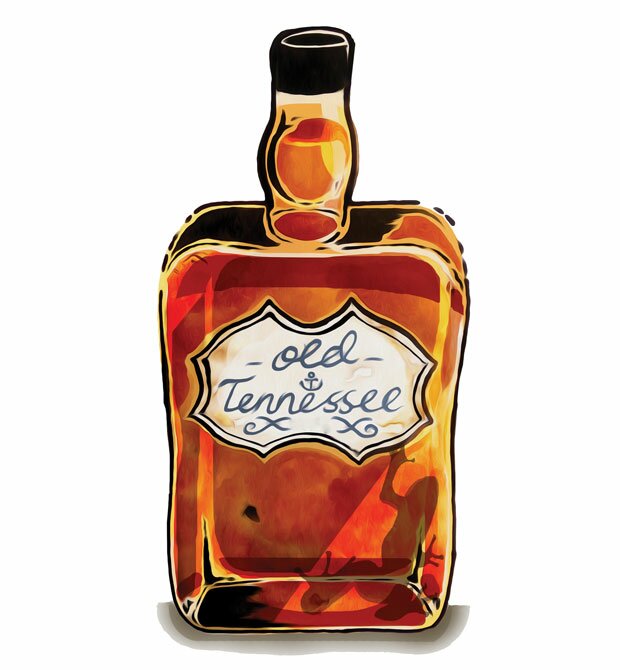
Novel: Cannery Row
Author: John Steinbeck
Year: 1945
Illustrated by: Becca Broad
If Old Tennessee were a genuine brand then the owners of the grocery store on the former Ocean Avenue in Monterey, California would be making a fortune, even if the whiskey was accurately appalling. John Steinbeck fans flock from all over the globe to Cannery Row, the street named after his 1945 novella of the same name. Old Tennessee is a blended whiskey guaranteed four months old, very cheap, sold only at Lee Chong’s Heavenly Flower Grocery, and known by the row’s colourful denizens as Old Tennis Shoes. Alcohol often played an important role in Steinbeck’s work, both on the page and off, and its significance as a binding agent between the inhabitants of Cannery Row secured its place as one of the most memorable fictional drinks ever penned.
Casterbridge Strong Beer
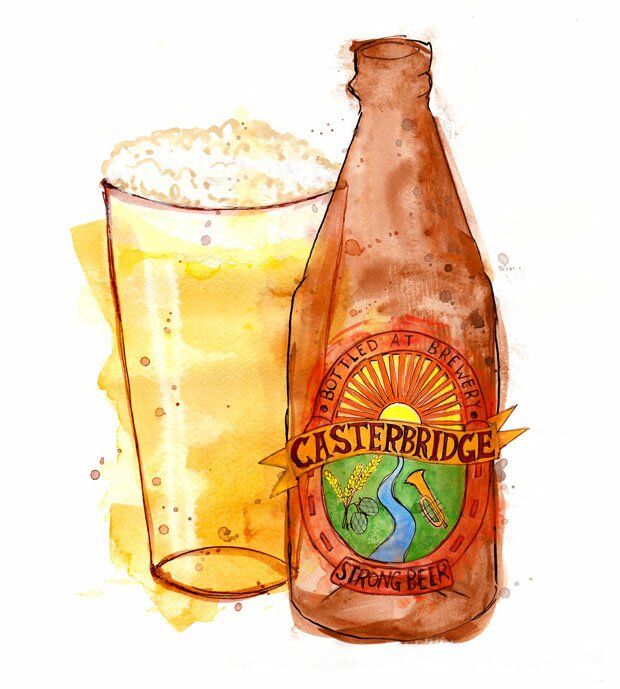
Novel: The Trumpet Major
Author: Thomas Hardy
Year: 1880
Illustrated by: Ieva Bielske
Thomas Hardy embodied all things English and was the incomparable chronicler of his very own Wessex. Nowhere is this more apparent than in his 1880 novel The Trumpet Major in which he introduces Casterbridge Strong Beer. “This renowned drink”, Hardy writes, “ – now almost as much a thing of the past as Falstaff’s favourite beverage – was not only well calculated to win the hearts of soldiers blown dry and dusty by residence in tents on a hill-top, but of any wayfarer whatever in that land. It was of the most beautiful colour that the eye of an artist in beer could desire; full in body, yet brisk as a volcano; piquant, yet without a twang; luminous as an autumn sunset; free from streakiness of taste; but, finally, rather heady.” Metaphoric idyll abounds in the appearance, scent and taste of this beer, yet true to form Hardy’s symbol of rural Victorian heritage has a sting in its tail.
Enjoy this article?
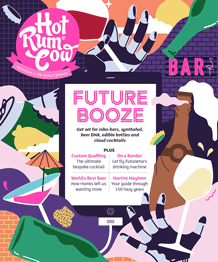
This is an excerpt from Hot Rum Cow Issue 6 which is available to buy in our shop. Buy magazine